What if that Sunday afternoon dread is trying to tell you something?
In my family, we called it the Sunday klegsies.
I have absolutely no idea where the word came from. But everyone knew what it meant.
It was that awful feeling that would begin creeping in sometime on Sunday afternoon. A knot in my stomach. A growing sense of anxiety. The realization that Monday morning was coming, and another workweek was about to begin.
I was a trial lawyer for more than 25 years. The work was intense, demanding, and relentlessly contentious. There were deadlines to meet, clients to satisfy, and adversaries to battle. The pressure never really let up.
I was pretty good at it. And it paid well. But I hated it.
I’d count the days until Friday. By Wednesday, I’d be thinking about the weekend. Friday afternoon brought an enormous sense of relief, as if I could finally come up for air.
But the relief never lasted long enough. By Sunday afternoon, the klegsies would begin again.
Turns out, I had plenty of company.
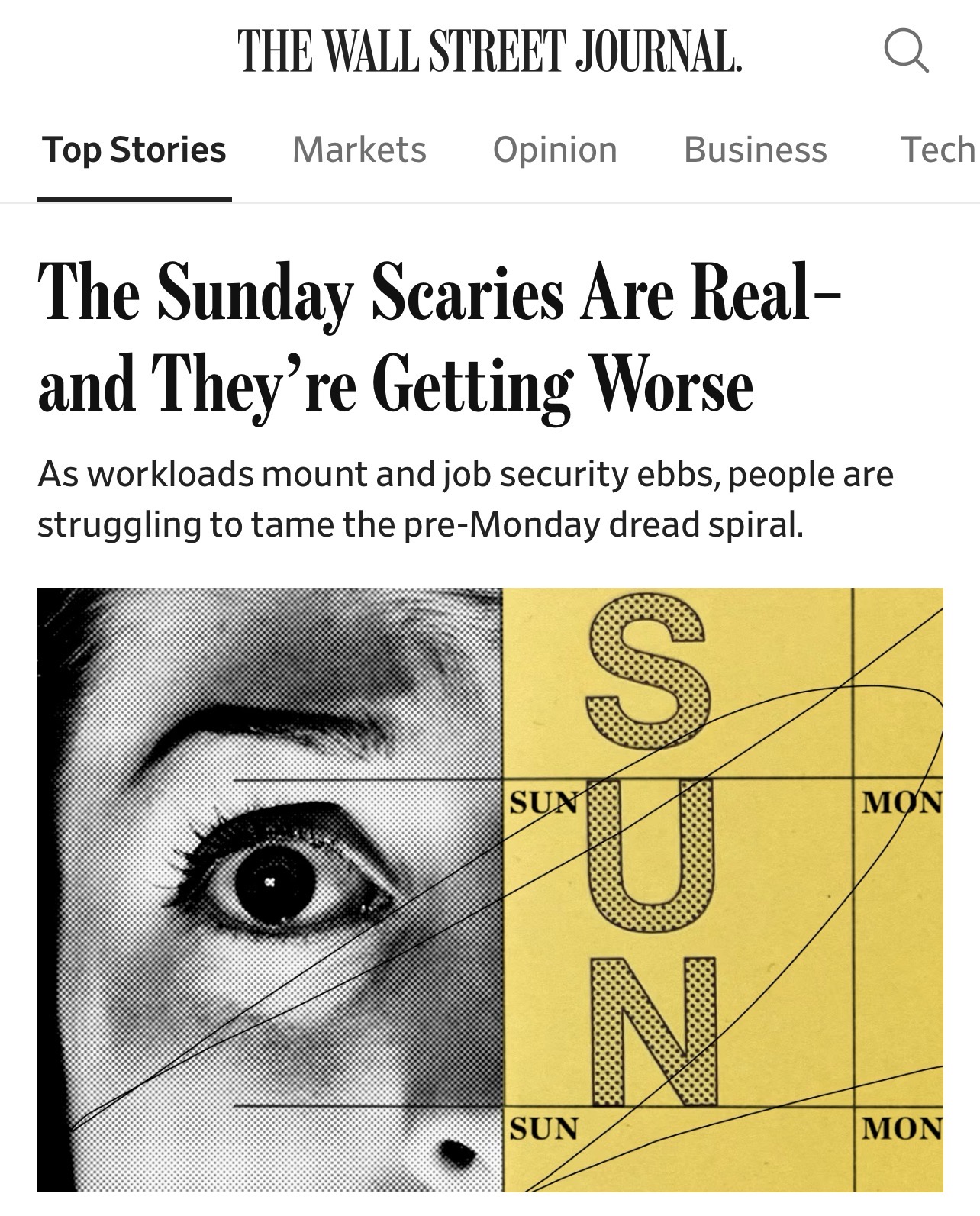
A recent Wall Street Journal article, The Sunday Scaries Are Real—and They’re Getting Worse, reports that more than half of American workers experience what we’ve come to call the Sunday scaries. And the phenomenon appears to be getting worse as workloads increase and job security becomes more uncertain.
The article offers some useful suggestions for managing that anxiety. Set better boundaries. Get organized before the weekend. Resist the temptation to spend Sunday catching up on work.
All good advice. But I wonder whether we’re asking the wrong question. Instead of asking how to make the Sunday scaries go away, perhaps we ought to be asking why they’re there in the first place.
For years, I knew something was wrong. I loved studying the law, but practicing it was another matter entirely. The constant conflict wore me down. I felt trapped in a profession that rewarded me financially while draining me emotionally.
So why didn’t I leave? Because I had responsibilities. Kids to raise. A mortgage to pay. A lifestyle to support. And because I was good at what I did, it seemed almost irresponsible to walk away.
A therapist I worked with called it the golden handcuffs. They were very real. Or at least they felt that way.
Looking back, I don’t regret the decisions I made at the time. I had responsibilities. But I wish I’d understood sooner that the skills I’d developed as a lawyer could serve me in an entirely different career. I had more options than I realized.
Eventually, I found my way into executive coaching.
And here’s the remarkable thing: I absolutely love the work I get to do. I love the people I work with and the opportunity to make a difference in their lives. I look forward to my days.
In fact, I’ve noticed something rather funny about Fridays. I sometimes feel a little melancholy when the workweek ends. I’m genuinely sorry to see it go. And I look forward to Mondays.
That doesn’t mean every day is easy. There are challenges and frustrations, just as there are in any profession. But there’s an enormous difference between working hard at something you love and working hard at something that’s slowly wearing you down.
There’s an old saying, often attributed to Mark Twain, that if you find work you love, you’ll never work a day in your life. I understand that sentiment now in a way I never could when I was practicing law.
Of course, not everyone can simply walk away from a job that makes them unhappy. I couldn’t. At least not for a very long time. And sometimes the Sunday scaries are the result of a particularly difficult season rather than a fundamental mismatch between who we are and what we do. But I think we ought to pay attention to what those feelings are telling us.
If you spend every week counting the days until Friday, and every Sunday dreading Monday, that’s worth examining. It may be time for a change in how you work. Or it may be time to begin imagining an entirely different kind of work.
You don’t have to make that change tomorrow. You might need to plan carefully, develop new skills, or create a financial runway that gives you room to move. But you can begin.
I wish I’d begun sooner.
Because one of the things I’ve come to understand is that the point of work isn’t simply to make a living. It’s to help us create a life worth living.
And while I wouldn’t wish those Sunday klegsies on anyone, perhaps they have something important to teach us.
Maybe they’re not something to get rid of. Maybe they’re something to listen to.