Walt Hampton, J.D.

Creating the Work & Life You LOVE

Racing The Sun

The tao that can be told is not the eternal Tao. The name that can be named is not the eternal Name. The unnameable is the eternally real. Naming is the origin of all particular things. Free from desire, you realize the mystery. Caught in desire, you see only the manifestations. Yet mystery and manifestations arise from the same source. This source is called darkness. Darkness within darkness. The gateway to all understanding.

Lao-Tzu

I looked up at the overhead monitor for the tenth time in as many minutes.  The little icon of the plane hadn’t budged.  It would be a long seven hours.

We were flying west from Ireland.  American Airlines graciously displayed the world map, our intended route, and the position of the plane.

I noticed that the display also marked the divide between night and day.  As we flew west, I could watch the dark creep up behind us.

It tends to do that.

We mark the fall equinox this week, that day when the light and dark are fairly matched. Darkness will overtake us soon.

I’m not fond of the dark.  Although some would argue that I am affected generally, I admit only to the seasonal variety.  As the days grow short, I fight to keep my mood from darkening too. The morning runs become more challenging.  It’s harder to jump into new projects after dinner.

I understand the need to hibernate.

But I forget sometimes the need to celebrate.

Autumn is a time to do that.

In the spring, we plant.  In the summer, we cultivate.  In the fall, we enjoy the harvest, the fruits of our labors.

This is the rhythm of things.  In nature.  And in our lives.

I have such a tendency to tick off goals.  And then move on to the next one without ever stopping to appreciate the effort, savor the moment, reflect on the journey, enjoy the accomplishment, celebrate the success.  Mount an expedition to Aconcagua: check. Summit Denali: check.  Marathon training: check.

Ireland marked a wedding anniversary with the most wonderful partner I could ever imagine: check.

And the countless smaller joys: stimulating work, healthy and successful kids, a wonderful staff, spectacular friends, a beautiful home.  Check, check, check and check!!

How is it that I can get so busy, so tunnel visioned,  that I pass all these things by like Burma-Shave signs on the highway, like mile markers on the interstate?

Celebration is such a core component of our lives. I suspect that we have done it for as long as we have been aware of our humanity.  And seen, albeit dimly, our connection to divinity. In cave dwellings. In great cathedrals. Around our tables. That need to celebrate is part of our DNA. And yet the demands of our daily lives cause us to forget. Or so deplete us that we cannot know our joy.

It is time for Autumn. It is time to harvest what we have sown and cared for.  To stop. To appreciate. To be grateful. To celebrate with the bounty that belongs to each of us. I know it is for me.

My photography mentor Galen Rowell was fond of saying that there is an intensity at the edges of things: earth and sky, land and sea, night and day.  At this autumnal edge, I want to be intensely grateful.

We landed in Boston.  The shadow of darkness had overtaken us.  But in the morning, the sun came up again.  It always does.


“Benedicto: May your trails be crooked, winding, lonesome, dangerous, leading to the most amazing view. May your mountains rise into and above the clouds. May your rivers flow without end, meandering through pastoral valleys tinkling with bells, past temples and castles and poets’ towers into a dark primeval forest where tigers belch and monkeys howl, through miasmal and mysterious swamps and down into a desert of red rock, blue mesas, domes and pinnacles and grottos of endless stone, and down again into a deep vast ancient unknown chasm where bars of sunlight blaze on profiled cliffs, where deer walk across the white sand beaches, where storms come and go as lightning clangs upon the high crags, where something strange and more beautiful and more full of wonder than your deepest dreams waits for you — beyond that next turning of the canyon walls.”

Edward Abbey

Where The Fudge Leads

This is best done in a darkened kitchen well after the hubbub of the day.  Have a ready “explanation” for what you’re doing.  Maintain plausible deniability at all times.

The materials required are: a fresh half gallon of fudge ripple ice cream, and a teaspoon. (It’s also handy to have the daily newspaper nearby so as to appear preoccupied with current events.)

With the teaspoon, follow the fudge.  Sometimes the ripples peter out.  But sometimes they end in a jackpot: a vast reservoir of chocolate fudge.

You never know.

Ripples are like that.

I love Success Magazine.  I purchased a gift subscription for a business colleague thinking it might be helpful for him as he builds his business.  He thanked me for it and I know that he enjoys it.  Several months later, he told me that his wife, who suffers from depression, came upon the magazine and found many of the articles inspiring and uplifting.

An unexpected ripple.

Many years ago, a seminary classmate began the practice of paying for the order of the person behind her at the Dunkin’ Donuts Drive-Thru. And ignited a movement of generosity that grew like wildfire.

A random act of kindness.

Ann writes a tough no-nonsense blog entitled Things Momma Never Taught Me. Some of her friends have found it a bit “much” because of some of the “heavy” topics she’s handled. The mom of one of these friends discovered one of Ann’s pieces and found it comforting as she grappled with the terminal illness of someone close to her.

An unintended consequence.

I’m a big fan of a wonderful blog called Little Things Matter by leadership expert Todd Smith. “Every little thing you do, or don’t do, is noticed,” says Smith.  And impacts others in ways we cannot possibly begin to imagine.

I’ve always thought the “Butterfly Effect” to be an elegant and intriguing theory. Based upon the work of Edward Lorenz, a chaos theorist, the term is a metaphor for the initial conditions in a physical system that have the capacity to effect massive change.

According to Lorenz, the flapping of a butterfly’s wings can create tiny changes in the atmosphere that may ultimately alter the path of a distant tornado. Had the butterfly not flapped its wings, the entire chain of events would be different.

A little bit like the notion of karma in Buddhist teaching. The law of karma says only this: “for every event that occurs, there will follow another event whose existence was caused by the first, and this second event will be pleasant or unpleasant according as its cause was skillful or unskillful.”  Our actions have consequences. All of our deeds shape the past, present and future.

I never cease to be floored when something I say or do in passing and without intention “means” something to another.  And chastened when something inadvertent has caused hurt.

With mindfulness, we have the capacity to impact so many lives as we move through our days. A smile, a small deed, a kind word can lift the spirit and alter the trajectory of someone’s day. And in turn make a difference in the lives of countless others.

The image often used is the pebble tossed in the ocean.  The wavelets washing up on shores beyond our view.

Little things do matter.  Wherever the fudge leads.

Kindness

Before you know what kindness really is
you must lose things,
feel the future dissolve in a moment
like salt in a weakened broth.
What you held in your hand,
what you counted and carefully saved,
all this must go so you know
how desolate the landscape can be
between the regions of kindness.
How you ride and ride
thinking the bus will never stop,
the passengers eating maize and chicken
will stare out the window forever.

Before you learn the tender gravity of kindness,
you must travel where the Indian in a white poncho
lies dead by the side of the road.
You must see how this could be you,
how he too was someone
who journeyed through the night with plans
and the simple breath that kept him alive.

Before you know kindness as the deepest thing inside,
you must know sorrow as the other deepest thing.
You must wake up with sorrow.
You must speak to it till your voice
catches the thread of all sorrows
and you see the size of the cloth.

Then it is only kindness that makes sense anymore,
only kindness that ties your shoes
and sends you out into the day to mail letters and
purchase bread,
only kindness that raises its head
from the crowd of the world to say
it is I you have been looking for,
and then goes with you every where
like a shadow or a friend.

— Naomi Shihab Nye

Four Wheelin’

He who has a why to live for can bear with almost any how.

— Nietzche

It was like a Giant Slalom course.

Careening back and forth, I deftly avoided the holes and the heaves in the road.

“I think I’d take it a little slower,” Dave said from the back seat.

I smiled at him through the rear view mirror and pressed the accelerator a bit harder.

It was late winter and Jefferson Notch Road was a combination of ice and snow and rutted rock. Perfect for my all-wheel multi-purpose trusty reliable Outback.

Until I saw the branch a bit too late.  And swerved.  And caught the icy patch. And landed in the ditch.

Ten miles from the main road without cell phone coverage.  Late in the day. Without much prospect of another passing car.

“Landed” would be a euphemism for impaled, upended, kinda screwed.

As September looms, I am aware of my propensity to careen.  The lazy days of summer seem to nurture a sense of healthy aimlessness in me.  But as they give way to the fall, there is a return to schedule and routine.  Greater portent. Obligations and Expectations and Commitments.

The days packed full, one ebbing into another.  Labor Day becomes Columbus Day becomes the Holidays.  Life lived in a particle accelerator.  Full and satisfying.  But also stupefying in its blur.

Lived without a lot of presence. Or much appreciation for the moments granted.

Buddhists speak of our precious human existence.  Of our unique potential for enlightenment. But how much of it we miss by failing to show up. By failing to hold in awareness all that we have been given. One moment careening into another, evaporating like drops of water on a hot griddle.

My most important summer read was Victor Frankl’s Man’s Search for Meaning.  I was so moved by Frankl’s capacity to be in touch with beauty and dignity and purpose even in the most horrific of circumstances.  How is it that he could appreciate the watery soup and morsel of bread when in the comfort of my suburban banality it is a chore to remember the sauteed shrimp I had last night? How is it that he could find goodness and decency in the prison guards who persecuted him when I sometimes struggle to find such qualities even in those I love? How is it that he could find hope as his friends were led to the crematorium when I find bleakness in something as transitory as the failing daylight? How is it that he could marvel in a sunset through the barbed wire when sometimes I cannot even remember to look?

Frankl reminds us of our power to chose.  In every moment.  To chose: to cherish every fragment of time. To appreciate every opportunity. To hold dear to beauty.

“We who lived in concentration camps can remember the men who walked through the huts comforting others, giving away their last piece of bread.  They may have been few in number, but they offer sufficient proof that everything can be taken from a man but one thing: the last of the human freedoms – to choose one’s attitude in any given set of circumstances, to choose one’s own way.”

I was brought up short this week by a quote passed on by Tony Robbins: “Somebody is in the hospital begging God for the opportunity you have right now. Step into your moment.”

It is so easy to step over the moment, through the moment, under the moment; but never to dwell in the moment.  Failing to recognize the richness of the opportunities that stretch before us. Right here, right now. Forgetting to appreciate the countless blessings that our precious human existence brings.

Even as I mourn the loss of a beloved pet and grapple with the looming tuition bills and wrestle with the countless commitments of a new season, I want to chose to see beauty. To careen less. To avoid the ditch.

Dave was right.  It would be better to take it a little slower.

It is we ourselves who must answer the questions that life asks of us, and to these questions we can respond only by being responsible for our existence.

— Victor Frankl

Joe Black and The Dog Days of Summer

It was a few weeks ago that I noticed him.  Standing in the shadows.  I recognized him immediately, of course.  Joe Black.

In the movie, Joe Black [Death] is Brad Pitt handsome, suave, and sophisticated.   Coming all too soon for the media mogul played by Anthony Hopkins, Joe agrees to a reprieve in exchange for a tour of life on earth.

In real life, Joe Black isn’t handsome.  And he doesn’t negotiate.

Her weight loss was what I first noticed. And her energy was off.  I chalked it up to the summer heat. But as the days passed, I knew something was amiss.

“Lymphoma,” the vet said. (Joe nodded sagely in the corner behind him.) There was time, said the doctor.  Options. Treatments.  (“It’s a lie,” Joe said.) The words became a blur as my legs buckled beneath me.

We took Sammy home.  We lived those next weeks with such tender care, such focus, such determination. And Sammy lived like royalty.

On a rare and glorious summer day, with my precious son, her master, we walked together the paths of seasons past, visiting the haunts of carefree boyhood, knowing all the while in the recesses of our hearts that today we had the cares of men.

I watched as Sammy nuzzled and played with my boy.  The sky clear, the summer sun warm. The moments filled with unbounded joy.  And tinged with that contingent sadness that came with the knowing that these days of summer would be all too brief.

I could feel the gentle breeze from  the fetch of the lake. Across the sweeping field of fresh cut grass, I saw Joe watching.  I pretended not to see him.

With such intensity we held her close and whispered in her ear.  A noble dog.  The treasured one who had brought unbridled joy to a young boy’s heart.  The one who played with him and walked with him, in the rain and in the snow.  A creature who knew only love, no matter the seasons of the year. Or of life.

The day grew short. In the parting, there was such grief.

I held her as she slipped away. My hands still ache from the digging in the hard, dry earth.  I laid her to rest beneath the apple tree in the yard in which the boy became a man, the place they both loved so much.  I worry that she will be wet and cold and lonely.  I miss her terribly; and I grieve the empty place in the heart of my sweet boy that I can never heal.

I know why the great masters have always sent their students to the charnel grounds.  It is only there that we begin to burn with the recognition of all that is so transient.  And learn to find the truth in what remains.

It is perhaps Joe’s one and only gift, that lesson seared by our mortality: live.

I want to live these last days of summer with urgency and fervor.  To know the crisp morning air, to feel the intensity of the sun, to hear the sounds of the crickets and the bats, to watch the flickers of the fire flies in the dying light.

Summer wanes.  Sammy’s gone.  I scan the perimeter for Joe Black.  I don’t see him. But I know he’s there.

Beyond the Green Door

As a man thinketh in his heart, so he is.

— Proverbs 23:7

I was pretty sure that I was going to pass out.  Or throw up. Or both.

This was no Marilyn Chambers moment.  It was more Linda Blair.

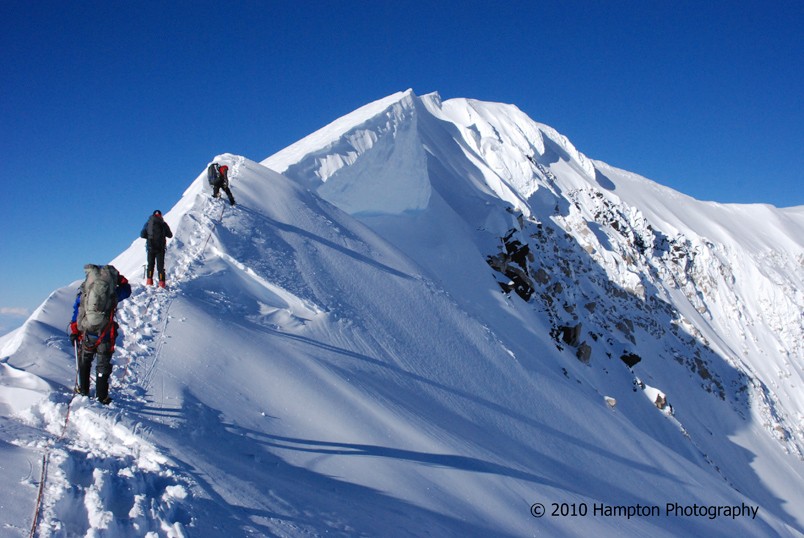
We were below Denali Pass at about 18,000′.  The day was clear and nearly windless.  I had been feeling strong. But as the terrain steepened along the Autobahn, my energy began to wane. And there was still a long way to go.

I knelt down to clip through our running belay. When I stood up, my head spun. My eyes wouldn’t focus. The steep slope began to undulate like the surface in a second-rate carnival house.

I willed myself to move forward.  My heart raced and my chest heaved.  I couldn’t catch my breath.  I wanted to sit down.  I wanted it all to stop. I wanted out.

I had hit The Wall.

I argued with myself.  My intellectual self said the smart thing would be to go down. The mountain will always be here. My emotions screamed, “how can you walk away again? It’s not likely you’ll come back.” And the voice of my father in the back of my head: “There are old mountaineers and bold mountaineers but few old, bold mountaineers.”  Did I really want to spend it all in this cold, barren place?

Just get to Denali Pass, I told myself.  It’s flat.  I can rest. I can decide to go down from there.

An hour later, I collapsed onto my pack, certain that the trip was done for me.

I sucked down two packages of Gu and gulped some water. I got hold of my breath and closed my eyes.

The Wall evaporated.

Suddenly, it was all possible again.

All of us know The Wall.  All of us have smashed up against it more than a few times: in our financial lives, emotional lives, relational lives. And countless other places.

Race car drivers know that when you focus on the wall, you’ll hit it.  “The driver who cannot tear his eyes away from the wall as he spins out of control will meet the wall; the driver who looks down the track as he feels his tires break free will regain control of his vehicle,” writes Garth Stein in his passionate and loving story The Art Of Racing In The Rain.

But what happens when we do hit The Wall?

It’s easy to lay crumpled at the base of it.  I know.  I’ve spent a fair amount of time there.  It’s easy to turn around.  To decide that The Wall is too hard, too thick, too high.

But here’s the thing:  The Wall isn’t Real.  I’m not saying it doesn’t feel real.  It does. It hurts when you hit it.

But when you touch it, and know it, it dissolves.

Remember when the four-minute mile was thought to limit of human capacity? Now high school students can run four minute miles.  Records are constantly broken, new discoveries made. There is no limit to what we can accomplish and achieve.

Teachers of success principals know that the difference between failure and success is often one of simply showing up and persevering.  Darren Hardy uses the analogy of the hand pump on a well.  When you first start pumping, nothing comes out.  If you keep pumping, there may be a trickle even though you’re exerting a lot of effort. It’s tempting to give up.  But if you just pump a little more, just stay at it, just move beyond the frustration, beyond the discouragement, a steady stream flows out. In abundance.

Dozens of publishers rejected Jack Canfield’s Chick Soup for the Soul before it went on to become a meteoric success.  Lincoln lost election after election before becoming President.

Gandhi reminds us that “divine guidance often comes when the horizon is the blackest.”

Tony Robbins teaches that when you are facing into life’s challenges and feel like you’re in the worst possible place, you really maybe only 2mm away from achieving your objective; that victory is near.

The difference between first and second place is often measured in fractions of a meter, hundredths of a second.

“Our doubts are traitors and make us lose the good we oft might win by failing to attempt,” Shakespeare wrote.

Banish doubt.  Know abundance.

It is easy to get discouraged by The Wall, to give up, to turn back.  But in our true state, we are bathed in the knowing that we are the flow, that there is no green door – no wall – but only infinite possibility.  And Joy.

DOWNLOAD your FREE BOOK!

The-3-steps-to-living-an-inspired-life

DOWNLOAD Your Free E-Book NOW! Click Below And Get Going!

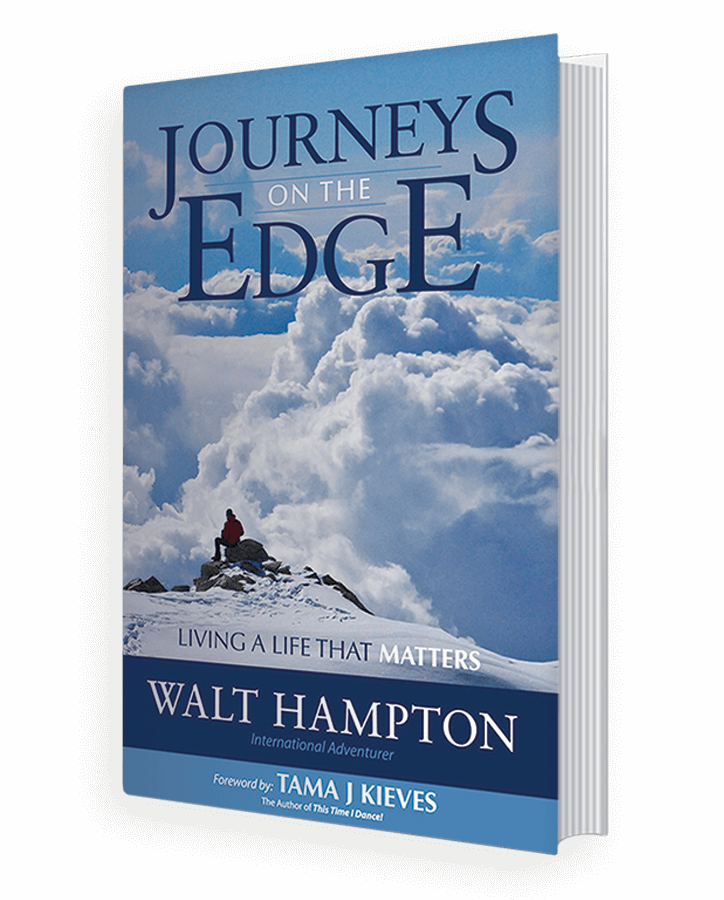
Click on the button for your copy of journeys!

Journeys-On-The-Edge

You’ll Get A Signed Copy!

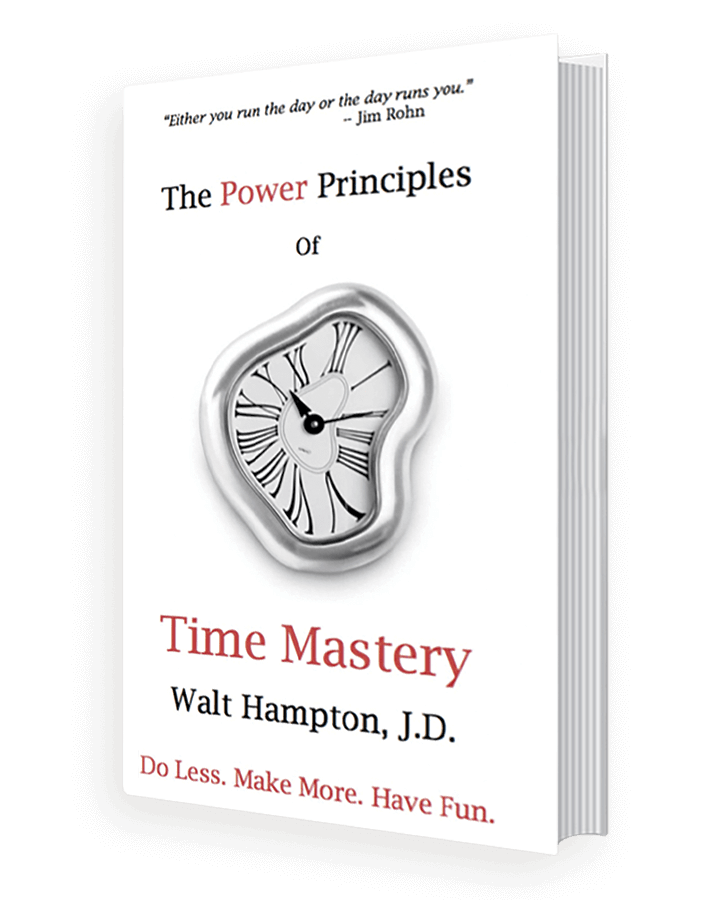
Click on the button for your copy of my brand new book “The power principles of time mastery!”

The Power Principles of Time Mastery

You’ll Get A Signed Copy!

REGISTER HERE

Free Online Training Workshop

Thanks for signing in to the workshop!