Welcome to my blog
Grow & Scale A Business That Will Set You Free
Sorry, That’s Not Going To Work For Me
Our psychological emergency brakes–negative images about ourselves, our comfort zone “prison” of can’ts, musts, must nots, our inaccurate beliefs about reality, our self-doubt–are all keeping us stuck.I figured it was time to take responsibility for myself so I could get unstuck, because blaming others hadn’t really helped.
 I started by rereading The Adult Children of Alcoholics Syndrome, just to confirm how I got so messed up in the first place. Then, done rolling around in the mud, I began ordering assertiveness and self-esteem and personal boundaries books off of Amazon like I was shoring up for Armageddon.Now, I hate God talk in books. If I see a reference to Jesus, or to the Bible, or to Tammy Faye Baker, I go running for the hills. That being said, as rife with church lingo as Boundaries is, this is one of the best books about setting healthy boundaries so people won’t eat you alive that ever landed on my doorstep.Ah, Boundaries.You know all those little anecdotal stories authors use to illustrate a point? Yah? Well, I saw myself, as I relate to others, in nearly every single one.I was the daughter backpedaling with her guilt-flinging mother. The wife doing back-flips to appease a disdainful husband. The mother rescuing her children from natural consequences. The friend giving away her precious time so someone else could take a break. The employee too afraid to ask for that overdue raise.Worse were the questions posed in Chapter 1:
- Do you bend over backwards to appease?
- Are you tired of trying to soothe your husband out of his tantrums?
- Do you find yourself feeling nothing more than resentment and fear?
- Do you sense that your life is out of control?
- Are you a master of taking care of the feelings and problems of others?
 I had to practice saying no a lot. I repeated, over and over again, “Sorry, that’s not going to work for me,” every morning while I brushed me teeth. I had to lean on my husband–a professional boundary setter if ever there were such a thing–whenever I faced a particularly gruesome challenge.Like that hysterical call from my twenty-two year old daughter. Who chose to take the Fung Wah bus from DC in the middle of the night. Even though I’d told her I wouldn’t pick her up from a depot half a state away at 3 am.Used to me rescuing her from every jam, she wasn’t “down for” facing her own irresponsibility. She needed to lose the illusion that she didn’t have to plan ahead like the rest us. That lesson, however, didn’t feel good. There were several moments I needed to be talked off the ledge.So if you answer yes to those very same questions. If you fantasize about running away to live in a convent. If the idea of making new friends makes you nervous because they represent one more time synch. Then you, my friend, have boundary issues, too.Life is short. But your calendar will open up when you learn what is your responsibility, and what is not.Only you know what you can and want to give, and only you can be responsible for drawing that line. If you do not draw it, resentment will rule.If this seems daunting, get some help.And know that I’m rooting for you.One more thing. If you want to know how those lack of boundaries are making you fat, check out Dr. Sara Gotfried’s article below.http://www.saragottfriedmd.com/2012/05/04/cortisol-switcharoo/#
Yup, It’s Possible
Years ago, I had the privilege of studying with the late great outdoor photographer Galen Rowell. Galen was an icon. He lived life on a grand scale and made some of the most beautiful, memorable, moving images of the natural world that exist today.
Galen believed that his most powerful images were made on the edges: On the edges of time and space: at the edge of land and sea; in the gathering dusk; in the face of the oncoming storm; in the gentle light of a new day’s dawn. 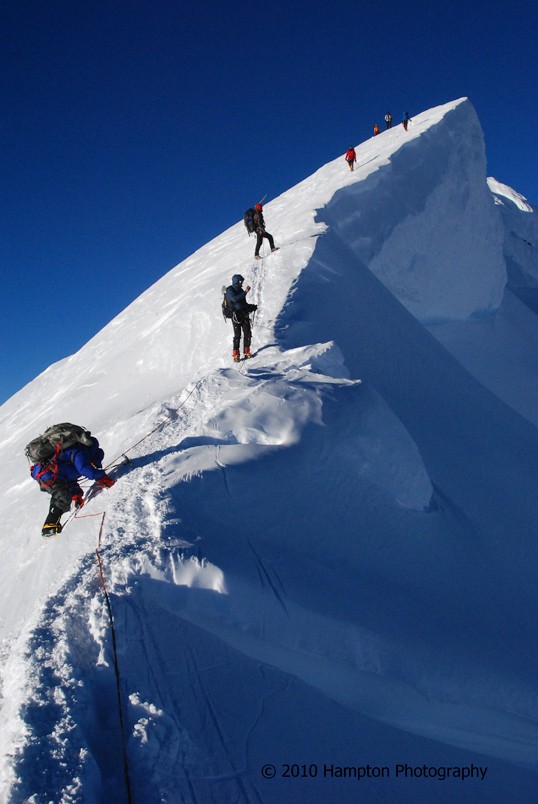
Edges are powerful. They are exciting and exhilarating. I know this one is. On the left, a drop of 1000’; on the right, a 5000’ drop across the great South Face of Mt. McKinley. Not much margin for error. It keeps your attention, your focus. It makes your heart beat fast. And, oh, yes, the view. You can see forever.
You can see what is before you… all that is possible.
Life is lived most poignantly along the edge. Where we are engaged and vital and alive.
When we find our edge in our jobs, our sales, our careers, our businesses, our professions, we are happier, more satisfied, more profitable, more prosperous.
When we find our edge in our relationships, we feel loved, appreciated, joyful and safe.
When we are healthy and fit, at the top of our game, when we push ourselves to the edge of what we are capable of, we feel energized, we feel as if we can accomplish anything.
What would it be like to have that edge in your life?
What would it be like to believe that what you dream of is POSSIBLE.
Here’s a well-kept secret. It doesn’t really take a lot of extra effort to up your game. Do you know what the time difference was between Michael Phelps’ recent Gold medal finish in the 100 meter butterfly and the dude who got the Silver? Two-tenths of a second! What’s water at 211º? It’s hot. At 212º it becomes steam… with enough power to drive a locomotive. Two-tenths of a second; a one-decree difference; just a LITTLE extra effort. And EVERYTHING is transformed. Everything becomes possible.
And here’s another well kept secret. Big changes don’t generally happen all at once. It’s small, consistent steps over time; a slow, steady pace that gets you to where you want to go. With a very moderate training schedule, you could run your first marathon inside of a year, even if you’ve never run before! If you lost just a 1/4 lb a week, that would be nearly 25 lbs over the course of a year! Just $2k deposited each year in a Roth IRA (less than 6 bucks a day) starting at age 20 would leave you a millionaire. And a date night just once a month with your significant other might well restore the sizzle to the steak.
So let’s think about the POSSIBILITY of just a LITTLE extra effort. Pick an area of your life; just one to start. Maybe it’s health and fitness; maybe it’s your work; maybe it’s your relationships. But imagine, for a minute, that you could crank it up just a bit; that you could make just a 10% improvement in the way things are. Imagine for a minute what it would be like to get up every day excited about your job; imagine what it would be like to have just 10% more money in the bank; a paycheck that was 10% higher; imagine being at your ideal weight again; the weight you were in high school; imagine coming home every night to a relationship that rocked your world.
What would that be like? Pick just one area. Think about it just the way you would want it to be. Imagine it, picture it, feel it.
Now, say to yourself: it’s possible.
Yes, it’s POSSIBLE.
Now begin.
Do You Use Bad Language?
My mother used to threaten to wash my mouth out with soap. Those of you know me well can probably guess why. 
All of us, though, have the capacity for bad language. And I’m not talking about the f-bomb kind.
What I’m talking about is the language we use when we view the world, when we consider our challenges, when we evaluate those around us; when we judge ourselves.
Is the world a benevolent place that seeks our good? Or is is dark and foreboding?
Do we ask what might go right? Or what will go wrong?
Are other people fellow journeyers on the path? Or predators waiting to take advantage of us?
How we “language” dictates how we feel about what “happens” to us:
Tony Robbins tells a story about a friend of his who got stuck in a broken-down, open-topped vehicle in the the jungles of Africa as night fell. His friend said: “My, this is inconvenient.”
- Is the line at the DMV, yet another example or government’s ineptitude? Or a chance to chat with a stranger?
- Is the traffic jam a disaster of existential proportion likely to lead to catastrophe and the demise of business as we know it? Or a magnificent opportunity to listen to some beautiful music or an inspiring lecture?
- Is the deal that just fell through the last best chance for profit and prosperity? Or is it a sign that a better opportunity lies ahead?
How we “language” what we face impacts how we feel about others:
Jack Canfield tells the story of standing in a line behind a man who was upbraiding a hotel clerk. Apparently the clerk had been unable to accommodate the man’s request for a larger room. The man went away extraordinarily angry. When Canfield’s turn came at the desk, he complimented the clerk on the kind and patient way in which the clerk had handled an unpleasant customer. The clerk responded, “The man probably was just having a bad day. He’s probably a very nice person.”
- What if the guy who cuts you off in traffic is really on the way to the hospital to see his dying mother? Would you feel the same rage?
- What if the cop who angrily tickets you for speeding just tried unsuccessfully to resuscitate an infant? Would you have the same indignation?
- What if your boss who has ignored your last two emails has just discovered that her daughter is hooked on heroin? Would you be so annoyed?
How we “language” impacts what we believe about ourselves:
- Do we believe that we are capable? Or that we lack in essential skills?
- Do we believe that we’re deserving? Or that the train has passed us by?
- Do we think that we’re the victor? Or do we play the victim?
How we “language” dictates our success:
- Are there options? Or blind alleys?
- Are there opportunities? Or just dangers?
- Are there possibilities? Or just problems?
From the start, we set the stage. Joel Osteen suggests that before we get up in the morning, we tell ourselves these words: “This day will be a great day. I’m expecting God’s favor. I know I’m well able to fulfill my destiny. I’ve been empowered to overcome every obstacle. I have the strength to overlook every offense. I have the grace to rise above every disappointment. Even if things don’t go my way today, I know God’s in control, and that I’m making up my mind right now to be happy and enjoy this day.” That would sure switch things up, wouldn’t it?
What if you used “good” language? What if you believed that anything were possible? What if you believed that you could make your wildest dreams come true? What if you believed that the Universe conspired for your good? What if you believed that the world was an abundant place and that there was enough to go around? How would that change up the way you approached the world?
Negativity pervades. How we language is a constant struggle. And yes, I’m fairly certain that my mother still wants to wash my mouth out with soap.
But Cy Coleman wrote, “The Best Is Yet To Come.” How ’bout we all work with that?
The Hill Will Always Be The Hill
We’re fairly deep into our ultra-training season. Our Saturday long runs are now 20 miles or more.
There’s a hill about a quarter mile from our house, at the start of our usual route. It goes on for about a 1000 yards or more, at a pretty steady grade.
I’ve run it hundreds of times. 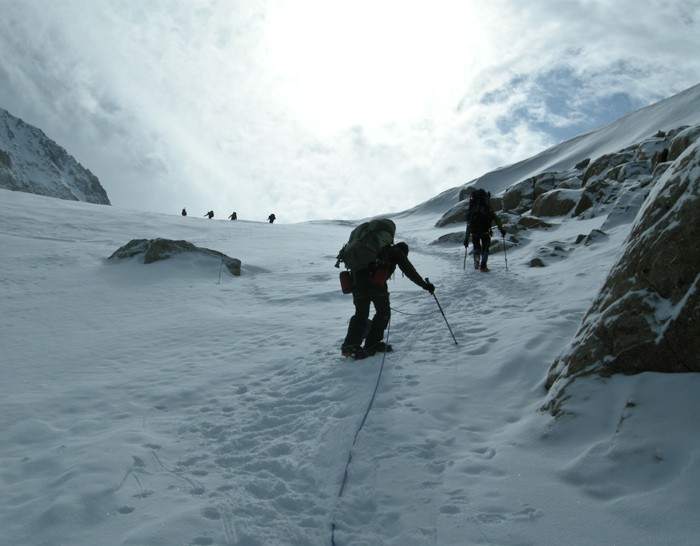
It’s always hard.
It never gets easier.
Sure, measured over years, my heart rate is probably lower, my breathing easier than when I first started running it. I do recover faster.
But the hill is always hard. And every time I start out, I think about that damn hill. And how hard it’s going to be. And how unfair it is that it never gets any easier.
(Yes, unfair, dammit. It’s unfair.)
And therein lies the problem: I think that the hill should be different than it is.
The hill is just the hill.
Suffering happens when we think that things should be other than they are.
- There’s always resistance when we start to write.
- A new job or school always takes us out of our comfort zone.
- A new diet always feels unfamiliar
- The hardest part about going to the gym is always getting in the car to go.
- A new project always requires more of our time and attention.
- Starting out on the trail with a heavy pack is always uncomfortable.
These things just are. Kinda like laws of physics.
Now, don’t get me wrong. I like to think of myself as an agent of change. I like to make shit happen. I really do. But we waste a whole lot of time and energy when we fight against the things that are.
Steven Pressfield in his wonderful book The War of Art reminds us that, regardless of endeavor, resistance will always be with us; that if we entertain it even for a moment, all will be lost; and that the only remedy when we face a hill is to climb it. When we succumb to resistance, when we allow it as an excuse in our lives, we succumb to fear, and settle for mediocrity.
So just settle down and do the work; get out the door and start to run; go to the gym and forget the drama; show up at the keyboard and start to type.
The real Secret is that there is no secret.
Ya just gotta do it. Ya just gotta start. Ya just gotta push through.
The hill will always be the hill.
No Competition
How do you stand out in the crowd? 
How do you get heard among the myriad talking heads?
How do you compete in this challenging economy?
The answer is: You don’t.
You don’t need to compete. There is no competition.
Years ago, I had the privilege of studying with the late great adventure photographer Galen Rowell. Late one afternoon, the dozen of us in the class set our tripods up side by side and, as the golden light faded across the Berkley Hills, our shutters clicked. We burned through countless rolls of film.
Now, one might predict that the photographs, made of this same vista, in the same place, with the cameras all pointed in the same direction, all at the same time, would be, well, … the same. But if you were to predict that, you would be wrong!
The twelve photographers came out with twelve very different sets of images.
Sure there was some similarities. But each of us had a different eye, a different view, a different interpretation, a different perspective.
And so it is in all our lives.
Each of us has unique gifts and talents; each of us has a way of seeing the world that is all our own; each of us has our own way of interpreting what we see; and each of us serves in a way that no one else can serve.
The problem is this: we lose sight of our own uniqueness. We get caught up in the noise of the marketplace. We become enmeshed in the fray. We want desperately to be picked, chosen, hired, retained. And so, paradoxically, we try to blend in order to compete; we become vanilla; and in the process we become invisible.
As I coach and strategize with folks who are out in the marketplace, I see them trying on veneers; endeavoring, without success, to dance to others’ tunes.
There is something about our essential selves, I think, that scares us. Perhaps we fear that we will be found out, found wanting; found unusual or strange; that we will be judged unworthy – because we fail to conform, because we fail to fit in.
I remember struggling with this fear as a young trial attorney. I was told that, really, the only way to get new business was to play golf. I tried valiantly to play golf. I hated it. And I sucked. As the years went by, I realized that my clients came to me, not through golf, which I abandoned with trepidation, but through the activities that I truly loved: mountaineering, climbing, hiking, sailing, outdoor adventure. The golfers had their clients; I had mine.
My own coach Tama Kieves reminds me that when we are true to ourselves, our people will find us. Our customers will find us. The right opportunities will come to us.
There are a bizillion accountants, financial planners, physicians, network marketers, lawyers and life coaches. There is only one of you.
You can never compete on price. You can never out-Walmart Walmart. There is only one important point of difference among all the competition: you.
The truth is: there is no one just like you.
Trust who you are.
Give to the world the gifts that only you can give.
No one can compete with that.
DOWNLOAD your FREE BOOK!
DOWNLOAD Your Free E-Book NOW! Click Below And Get Going!
Click below for your copy of Journeys!
You’ll Get A Signed Copy!
Click on the button for your copy of my brand new book “The power principles of time mastery!”
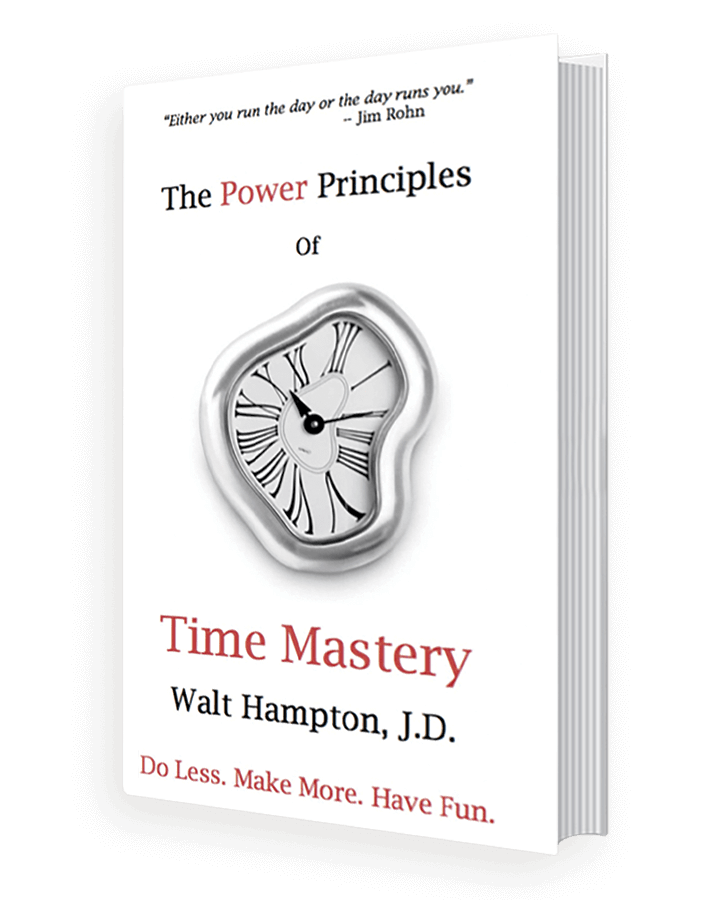
You’ll Get A Signed Copy!
Categories
Adventure
Finding The Way
Journeys
Leadership
Success
Ultra Training