Welcome to my blog
Grow & Scale A Business That Will Set You Free
Maybe You Need A Good Excuse
Excuses are good; really good. Because, if you’ve got a plausible excuse, then you’re safe… you don’t need to do anything; you don’t need to risk anything.
If you want to do, be or have something more for yourself; if you’d like your life to be different; if you’d like your health to be better; or if you’d like a job that makes you happy; or a relationship that makes your heart soar; and you’ve got an excuse… well, then, nothing really is required of you. 
You can just sit tight. Stay comfy. And let the clock run out.
Or not.
The Biggies
Here are the excuses I hear most frequently from clients:
- It’s not the right time. “I’m too old, too young, too fat, too out of shape. I need to save up some more money; I need to wait for the promotion or partnership or bonus; I need to wait until the kids are out of school; I need to wait until my partner retires or I retire; or… .”
The truth is: It’s NEVER the right time. There are ALWAYS obstacles. There are ALWAYS hurdles to jump; there are ALWAYS challenges to overcome.
Now is the only time you have. Tomorrow is promised to do one. Goethe says, “What you can do, or dream you can do, begin it; Boldness has genius, power and magic in it.”
- I could never do that. I’m not brave enough; fast enough; strong enough; fit enough; smart enough; wealthy enough; creative enough; ___________ enough.
I could never do that. I’m not enough.
It’s one of our core insecurities as human beings: That I’m not enough.
It’s why we strive. It’s why we have the Sistine Chapel and rocket ships and the computer and smartphones… because we achieve, we strive… because we forever strive… for more. But the worry that we’re not enough also stops us short; holds us back.
But we’re already enough. All we need is within us already.
Everyone starts from the same place. A Mozart, a Picasso, a Marconi; and some even start from hugely disadvantaged places: a Lincoln, a Mandela, an Oprah.
No matter where you start, you have enough – you are enough – to go the distance.
- It will take too long. It will take 4 years for the degree; 7 years for the residency; 6 months to train for the race; a year to lose the weight; 3 to write the book; and who knows how long to find the ‘right one.’
So what? Who cares? The clock is ticking. The time will pass; whether you take the next step; or not.
It may well take you three years to launch your new business; but the three years will come and go even if you never launch.
Greatness takes time. The overnight success has spent many a sleepless overnight. And while maybe you won’t need 10,000 hours to sharpen your skills, you still need to put in the effort.
Opportunity often disguises itself as work; and work worth doing – legacy work, generational work, world-changing work – often takes a long time.
- It’s too big; too hard. It’s complicated, confusing, overwhelming, I can’t figure it out. I don’t know where to research it; I don’t know who to talk to; I don’t know what to do next.
Even highly successful, highly accomplished professionals labor with this excuse. The more expert we become in a particular area, the more daunting it is to venture into a new one. We like the familiarity of our own turf.
And even highly successful folks have ‘blind spots.’ They may excel in the business life and struggle in their relationships; their finances might be stellar and their health in the toilet.
Too, we live in a culture of overwhelm. There’s so much flying at us all the time. We suffer from information overload. We resist wanting to take in more.
But what we need to remember is that every journey starts with a single step. Every ultra I’ve run, every mountain I’ve climbed… no matter how long or how big gets finished by taking one step… and then the next.
We want to see the entire way. But we don’t need to. “Take the first step in faith,” Martin Luther King, Jr. said. “You don’t need to see the whole staircase; just take the first step.”
In every endeavor, every business venture, every fitness goal, every financial objective, every marketing campaign, every piece of research, it’s just one step at a time.
And the hardest one is the first one. So just take it!
- It’s too risky. I don’t want to fail; I don’t want to lose my job; I don’t want to lose money; I don’t want to get hurt in another relationship; I don’t want to get injured. It’s too dangerous.
This is the most pernicious excuse of all because it seems to make so much sense. Why take unnecessary risks… why put yourself in harm’s way?
Guess what? Life is dangerous. None of us gets out alive.
I have a buddy who has been on Mt. Everest twice; summitted once. He shattered his leg cleaning out the leaves from the gutters on his one-story house.
We like to believe in stability; in constancy. But the only thing that is constant, the only sure thing is that things will change.
Businesses collapse, partnerships fail, marriages come unraveled, layoffs happen, people get sick, markets crash. And as much as we like to maintain an illusion of control, we really don’t have very much at all.
Our comfort zones are called comfort zones because, well, they’re pretty damn comfy. But what’s true is that the magic happens just beyond. Our greatest breakthroughs… our very best lives… are just outside that place of comfort. Life rewards those who risk.
What’s Next?
So excuses are good; in fact, they’re great… if you want to stay stuck. Not so much if you want a big life. The stories we tell ourselves are just that: stories. It’s as easy to make up a small story as it is a grand one.
Grand is better.
What are your favorite go-to excuses? And what will you do now?
_____________________________________________________________________
When you’re ready to bust through, let’s connect. Email me: [email protected]
Why Expectations Don’t Work
He was so frustrated. “She should have known that I needed her here at noon.”
My client, a very successful attorney, was baffled by the fact her paralegal hadn’t shown up with the file she’d been sent out to get from another lawyer’s office.
“Did she agree to be here by noon?” I asked.
“What do you mean? She knows how important this case is.”
The classic trap that business leaders and professionals fall into.
You can manage by expectation. Or you can manage by agreement.
Agreement is better.
If my client had sent her para out on this mission, told her that he needed the file by noon, and then said, “So, can we agree that you’ll get it back here by noon?” then the paralegal’s lack of timeliness is on her. But there was no such conversation. My client’s exasperation was based purely on my client’s expectation of what someone else “should” know. 
(The para had stopped for lunch. She had no clue.)
We make this error often in our personal lives too.
If I come home after a long day at an event, and go straight to my office to return calls without stopping to connect with my wife, and she seethes because I should have stopped to have a conversation, that’s on her.
If, instead, she says, “Honey, you know, when you come in at the end of a day, I would so love to connect with you before you start returning your calls. Would that be ok? Could we agree to that?” and I do, then the next time I blow by forgetting about her is on me. I didn’t live up to the agreement.
People – paralegals, partners, teenagers – aren’t mind readers.
Expectations are the stories we create ourselves. And they’re unreliable.
Use agreements instead.
____________________________________________________________________
When you’re ready to change up your leadership game, let’s talk. Email me: [email protected]
Hooked On Crack
I’m addicted. You are too.
Dopamine is the drug. Our smartphones are the delivery mechanism.
On average we check our smartphones 200 times a day. And every time we check them, we get a little hit of dopamine.
Dopamine is a pleasure-seeking neurotransmitter in the brain. It seeks out novelty. It’s stimulated by unpredictability. It thrives on anticipation. It wants more and different.
When we dive into our emails and text messages; when our news alerts go off; when we surf through Facebook and Twitter and LinkedIn; our brains are awash with dopamine.
And oh how we love our dopamine.
Like crack cocaine, it’s addictive.
The more we get, the more we desire it.
Research suggests that smartphone addiction can be every bit as powerful as drug addiction. Being away from our smartphones can leave us moody, anxious and panicky.
But that’s not the real downside.
Smartphone addiction robs us of our productivity. Interruption science demonstrates clearly that when we shift our attention from one thing to another, there is a drag on our focus, an attention residue. The drag has been measured: It takes us at least 11 minutes to re-focus completely. So some simple math: 200 checks of the smartphone x 11 minutes of lost attention per check = 36.6 hours of lost attentive productivity each day. (Talk about deficit spending. Not only do we feel as if we never get caught up, the reality is that we never really do.) 
Smartphone addiction robs of our ability to connect: to really connect with one another on a deep and meaningful level. To be here now in this one and only moment. To breathe in the air. To experience the present. To really relate to and honor one another.
(Next time you’re standing in line, look around you. Almost every head is down. Getting another hit of dopamine.)
Even more than that, smartphone addiction cause our brains become soft. We lose the ability to focus. We lose the capacity to do deep, uninterrupted work. Work that matters. Creative work. Breakthrough work. Legacy work.
In The Shallows, Nicolas Carr says, “We willingly accept the loss of concentration and focus, the division of our attention and the fragmentation of our thoughts, in return for the wealth of compelling or at least diverting information we receive.”
In a New York Times piece entitled Addicted To Distraction, Energy Project CEO Tony Schwartz writes, “One evening early this summer, I opened a book and found myself reading the same paragraph over and over, a half dozen times before concluding that it was hopeless to continue. I simply couldn’t marshal the necessary focus.”
Schwartz is not alone. I experience the very same thing all too often.
We all love a good hit of dopamine.
But if you really want to succeed, if you really want to thrive, get clean. Do what Cal Newport refers to as Deep Work.
Get focused. The future will belong to those who can.
___________________________________________________________________
Would you like to increase your focus and productivity? Go HERE now and download my free guide, 7 Productivity Hacks.
Set It & Forget It; Crash & Burn
I’m a big fan of systems.
Systems make things easy; safer too.
Pilots have systems; surgeons have systems; successful entrepreneurs and business professionals have systems.
Systems routinize. They reduce mind clutter.
You have a system for brushing your teeth. (Thank god, you don’t need to re-think that every single day.) You likely have a system for making your coffee; and onboarding clients; and scheduling appointments; and keeping track of your finances.
When you systematize things, you free yourself up. You can turn your attention elsewhere.
But you can’t just set them and forget them.
An airplane traveling between New York and London can be off course 90% of the time and still get to Heathrow, so long as the autopilot is making its moment to moment corrections. But if the autopilot goes awry, and the captain is asleep at the switch, the plane may end up in Cape Town.
Or worse.
A solo sailor in the around the world British Open Challenge ran his expensive, high performance racer onto an island in the middle of the night because of error in the auto pilot.
A coach of mine once said there are no people failures, only systems failures. If something in your business or your life isn’t working well, you need a better system.
Maybe. 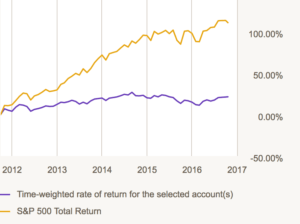
But I think we fail when we don’t check our systems to be sure they’re serving us well.
I recently checked the system I had put in place for one of my retirement accounts. Because I hadn’t reviewed it regularly, I belatedly discovered that I “enjoyed” a 15% return. But missed out on the 110% gain that I might have seen, had I been watching.
Oops.
That wasn’t a systems failure. That was my failure.
Good systems are essential for business (and life) success. And like everything in our planning practices, they need to be watched and reviewed.
You can set them and forget them; but you may crash and burn.
Why You Should Fool Yourself
I had to fool myself. It was the only way really.
It was raining hard. And it was rather dark. And I was tired. And my muscles ached.
I had a lot to do; a very full day.
I had a thousand excuses for not getting out the door to run.
But I’m a runner. And runners run. 
So I told myself a story: I told myself that I wasn’t going to run. No, instead, I told myself that I was going for a walk. A short walk. A very short walk. A walk just to the end of the driveway; maybe as far as the corner; certainly no further than that.
I laced up my shoes and put on my raincoat. Out I went for my walk.
Well, it wasn’t raining nearly as hard as I thought. The air was fresh and clean. It felt good to be out of the house. The morning light lifted my spirit.
I started walking faster.
Oh, how good it felt to be stretching my legs; the oxygen filling my lungs; the dawn beginning to clear.
I walked faster still. And a bit further. I told myself I’d go a bit further.
And soon I was running. Full out.
Smiling; laughing. Feeling so good in my body.
I finished my entire running loop.
But only because I fooled myself.
I need to do this from time to time (as in, a lot) when it comes to writing, or digging into a big work project, or when the yard needs raking.
I tell myself I’ll just start out; I’ll just do “it” for just 20 minutes; I’ll keep it short; I can quit whenever I want.
I fool myself into action. To overcome that horrible first law of physics: inertia.
Action begets action. (The second law of physics takes over: momentum.) I settle into the flow, and before I know it, the project is done.
Fool yourself. It works. I recommend it. Often.
___________________________________________________________________
When you’re ready to kick it up a notch, we should talk. I coach the fastest, easiest and most reliable system for getting more clients than you can handle, even if you hate marketing and selling (like I once did). Email me: [email protected]
DOWNLOAD your FREE BOOK!
DOWNLOAD Your Free E-Book NOW! Click Below And Get Going!
Click below for your copy of Journeys!
You’ll Get A Signed Copy!
Click on the button for your copy of my brand new book “The power principles of time mastery!”
You’ll Get A Signed Copy!
Categories
Adventure
Finding The Way
Journeys
Leadership
Success
Ultra Training