DIY or SOSDD?

A new year. Filled with opportunity; filled with possibility.

What will it be for you?

What will you do?

Where will you go?

How will you share your gifts?

How will you change the world?

You get to choose.

  • Will you choose health and fitness?
  • Will you choose work that deeply satisfies?
  • Will you choose a relationship that nourishes and enriches?
  • Will you choose to serve and share?
  • Will you choose to learn and grow?

Or will it be the same old same old?

Most folks who make such resolutions – and frankly only a few brave souls even bother – abandon the effort by the end of January (that’s right, by the end of this month). That’s because their “why” isn’t big enough; their drive not strong enough; their discipline not honed enough; their vision not clear enough.

And then one day ends up being just like the next; this new year just like the last. Same old shit different day. Dull, and bland and vanilla.

But it doesn’t have to be that way.

You can create a masterpiece. You can choose to make your life extraordinary. You can design a life lived on your own terms, rich and full and satisfying: A purpose-driven life.

Do It Yourself is not easy; it’s not simple. The DIY path is steep and winding.  There are obstacles and dangers; fears and frustrations; and failure along the way.

And it’s certainly not for the faint of heart. Those that take on the project of life design know that the road ahead will be filled with challenge, that they will need good mentors and coaches, that they will need to avoid the naysayers, that they will need to surround themselves with folks who will affirm their effort and support the journey.

But, damn, it’s a whole lot more interesting – and fun; a whole lot more textured and satisfying – filled with wonder and awe – than vanilla.

To live out loud; to push beyond your comfort zone; to explore the impossible; to live with intention and purpose, with passion and possibility, with vision and hope; to live a life designed and co-created; to share with the world the gifts that are yours alone to share; to serve at the highest level possible; to lead the way for others: That is your call.  That is the obligation that each of us has in the world.

And if you take on this challenge, if you live from that place of authenticity and vibrancy, then a year from now, you will look back and say, “Wow, what a ride this has been.”

Step up. This is your year.

________________________________________________________________________

CuttyhunkPath


If you’d like support along your chosen path, schedule a complimentary breakthrough strategy session today! Email me at: walt@walthampton.com

Identity Theft

What is your “I am” statement?

Don’t go skipping through this blog so fast. Stop and answer the question.

How we define ourselves really matters. It determines everything: It determines whether we succeed or fail; whether we prosper and thrive; or whether we suffocate, wither and die.

I’ve spoken recently to a number of groups comprised of folks who are unemployed, under employed, between jobs. I’ve heard countless “I am” statements that sound like “I am unemployed;” “I am unable to find a job;” “I’m unable to work.” “I am out of options.”

While all of these statements I am sure are heartfelt and seem true, they are also incredibly narrow, limiting, self-defining. They’re not the totality of potential.

And they’re certainly not the purview of only those who face employment challenges.

In my coaching, I hear “I am” statements all the time: “I am too old to do that.” I’m too out of shape.” “I’m too busy.” “I’m too stressed out.” “I’m not smart enough.” “I’m not someone who could ever do something like that.”

Then there are the organizations and the more-than-a-few substance-related groups that require their members to brand themselves with an “I am.”

And of course, my favorite “I am” stories are the ones I hear at networking gatherings and cocktail parties: “I’m an accountant.” “I’m a lawyer.” “I’m a financial planner.” “I’m a network marketer.”

We guys particularly enjoy these. There’s nothing like some good professional muscle flexing. “My ‘I am’ is definitely bigger than yours.”

“I am” statements become our realities, our narrow focus, our limiting beliefs; and the prisons of our minds.

It is the very worst form of identity theft: we steal our own potential by the tiny stories we make up about ourselves.

(And others.)

I love that scene from Exodus when Moses first meets God in the burning bush. God’s got a bunch of important assignments for Moses to be about. But before Moses heads back down the mountain, he wants to cozy up to God. So Moses asks for God’s name so that he can tell his peeps that he’s on a first name basis. God says, “I am who I am.” Tell them, “I am sent you.”

Of course generations have pissed and moaned, argued and fought, waged war and lobbed bombs over what they think ought to be tacked onto God’s “I am.”

But the bush wasn’t having it. Anything after the “I am” only serves to diminish.

The Universe is limitless; just as you are limitless.

Your “I am” statements can lay you flat; or make you fly.

So why not try on some new ones?

How about: I am abundant; I am loved; I am wealthy beyond measure.

Or try this one: I am unstoppable.

Think beyond the lines; think outside the box; in fact, just for a few moments, pretend there is no box.

What would yours be?

Write it down, make it real, share it in the comment section below.

Doing It On Purpose

We shall never cease from exploration
And the end of all our exploring
Will be to arrive where we started
And know the place for the first time.

— T.S. Eliot

I spent years; decades even.

I conferred with priests and ministers.

I consulted with counselors and therapists.

I sought out spiritual directors and shamans and energy healers.

I even hired a high priced consultant.

I was looking for my “purpose.”

I’ve discovered that I wasn’t alone.

I’ve come across lots of folks in the course of my coaching practice lately who are searching for their “purpose.” Folks from all walks of life; between jobs; coming out of dissolving marriages (and in happy ones); looking for the next step (or the first one); weary of their professions (or just ready for a change); certain that there is something “more,” but without a clue as to what that “more” might be.

They’re searching for their purpose because, for many, finding it really does matter. Because living day to day with a sense of purpose is important. Because, ultimately, we all want to make a difference with our lives; we want to make an impact; we want to leave the world a better place.

Purpose is a sense of mission, a vocation, a calling; a grand arc. More than a job or a role, it’s a sense of wholeness that weaves the pieces of our lives together.

The act of searching, though, can become a distraction; an excuse; a reason not to get our hands dirty, to buckle down and do the work. Searching for our purpose sounds important. And if we’re doing something as important as searching for our purpose, like a Holy Grail, how could we possibly have time to find the job, get the degree, launch the product, write the book, paint the picture or compose the song? Those are things you do after you’ve found your purpose! I should know! I’ve engaged in my fair share of circle jerking purpose searching.

“So how do you find your purpose? people ask.

I’ve discovered that it doesn’t have to be rocket surgery.

What excites you? What lights you up? What quickens your heart? What draws you like a moth to a flame? Where do you lose yourself in time? What have you always wanted to do? What brings you joy? What would you do, even if you weren’t getting paid to do it?

Sometimes we think that “doing” our purpose has to be hard; or that working at our purpose will require toil and sacrifice. But just the opposite is true.

Ask yourself instead: what makes you happy, what’s fun? In fact, ask yourself what would be too much fun to do?  That likely will point you in the right direction of your purpose.

But, ultimately, remember this. We really don’t have the time to search for yetis or lost cities. The clock is running. And every second counts.

Just get busy. Purpose has a way of finding you.

Purpose is about discovering what has been within you all along.

It’s about loving deeply and serving freely; it’s about sharing the gifts that only you can share with the world.

Likely, your purpose is close at hand; right here; right now; right where you are. Doing the work you are doing in this very moment.

Don’t miss it.

It’s The Journey, Stupid

She rolls her eyes when she says it.

“Whatever.” (Pronounced whaaatevvvverrrrrr.)

And it’s usually accompanied not only by a derisive snort but also by a look of exacerbated irritation.

As a definitely “not-whatever” kind of guy, I find myself feeling extraordinarily pissed off whenever this word comes out of my sweet stepdaughter’s mouth.

But I’ve begun to wonder whether it might be worthwhile to develop a better “whatever” frame of mind.

I had the privilege recently of guiding the first ever Special Olympian in his quest to climb Mt. Rainier. From a mountaineer’s perspective, achieving the 14,410’ summit is a significant objective: the mountain is big, steep, heavily crevassed and technical.

This was to be a barrier-breaking expedition. There had been extensive publicity.

We had assembled a strong team. We had planned extensively. We had trained with Patrick for months. We had done numerous fund-raising events. We had flown across the country with hundreds of pounds of gear. We had set aside eight days during the most favorable time of the year.

We had carried heavy loads across hot glaciers and established a high camp at 11,000’. We had had near-perfect weather. The route had never been in better shape.

On the night of our summit bid, the sky was crystal clear. The wind was light. The stars were so close we could touch them. The temperature was moderate. The snow was perfect.

The summit – victory – was near.

Although I knew the challenges of getting Patrick safely to the top and back again were huge, I was focused, single-minded, determined. I would achieve this objective. I would accomplish this goal.

I could taste it.

And then Patrick sat down on his pack. It was just after dawn. We were at 13,000’. Still more than 1000’ to go. He was spent.

Altitude had taken its toll.

I suspected I could coax him further on. The team was strong. But the terrain is unforgiving. And it was a long, long way back to base camp.

I made the heart-wrenching decision to turn the team back.

My glacier goggles hid the tears; the thin air good cover for my wrenching chest.

Back in the tent, I wept.

I had wanted that summit so badly.

I felt like I had failed; like I had let Patrick down, that I had let his parents down; like I had diminished the hopes and aspirations of the organization that so ardently supported Patrick, and his countless fans; and like I had failed the organization’s visionary executive director who had become a dear friend.

When I emerged from the tent a couple of hours later, Patrick was smiling. He was wondering when we were going to go back to the car, back to Seattle, whether there’d be a hot tub in the motel room, whether he might be able to buy a new set of headphones.  

He was happy.

He had let it go.

To strive and not attach. To hold the vision and not the outcome. To be fully present and alive in each and every moment. This is the greatest of Buddhist wisdom; so easily set aside in this age in which success is valued above all else.

It is, of course, about the journey. (And this journey was so fine.)

Patrick, my great teacher once again.

I must learn to say “whatever.”

The question: How are you at saying “whatever?”


If You Knew

I went to the woods because I wished to live deliberately, to front only the essential facts of life, and see if I could not learn what it had to teach, and not, when I came to die, discover that I had not lived.   — Henry David Thoreau

A friend of mine died two weeks ago today.

Suddenly. Unexpectedly.

Another friend found him – but not in time.

He was a wonderful human being: intelligent, articulate, funny, gentle, compassionate and giving. He was a devoted husband; and an adoring dad. His impact on the world was reflected in the swath of the grief  – and in faces of the hundreds who lined up in the hot June sun to pay their last respects.

He was 56.

His death has haunted me so: Arbitrary. Capricious. Unfathomable.

Our children had come of age together.  We had so recently talked and laughed and shared a meal. We were close in age. And I saw in him an uncommon zest, and zeal for life.

I am certain that when he woke up that Thursday morning two weeks ago, he had no idea that it would be his last.

And I began to wonder, how would I live – what would I do differently – if I knew?

If you knew, would you let the warm shower run a moment longer down your back? Would you savor those first moments with your coffee?

Would you walk barefoot in the dewy grass? Feel the breeze across your face? Would you watch the light play across the spider’s web?

If you knew, would you harbor the grudge, indulge the guilt, hold the anger?

Would you check your email one last time? Spend an hour less on Facebook? Care about your Twitter stream? Drive quite so fast? Fret as much? If you knew?

What would you write, who would you talk with, what would you share?

Would you curse the moments at the light? Worry about the dry cleaning or the dishes in the sink?

If you knew today would be your last, would you make the call, heal the rift, hold the child, write the poem, paint the picture, dance the dance, sing the song?

Would you linger just a moment longer in your lover’s arms?

Would you get up early to watch the sun rise one last time?

If you knew?


Bad Weather and Dead Racoons

I’ve had a lot of worries in my life, most of which never happened.
Mark Twain

Some folks seem to be blessedly care-free. They never seem to worry. Many, though, find themselves anxious and unsettled on a regular basis.

There is certainly plenty to worry about in the world: Afghanistan, unemployment, a nuclear Iran, the price of gas, death, disease and hurricanes to name just a few popular topics.

A coaching client of mine recently shared with me her worry. Her young daughter had a run-in with Leukemia. Now in complete remission, the daughter radiates health and happiness. The likelihood that she’ll live to a ripe old age is extremely high. Yet, my client says,  “I can’t stop worrying that it (the disease) will come back. I want to enjoy every moment of the day. But I don’t know how.”

She worries too about animals getting hit by cars. (Hey, who am I to judge. I have my own fairly random list.)

Of course, as a coach, and as a Professional (Certifiable) Worrier, I had some pithy thoughts to share with her on the topic of worry. Here’s what I said:

1. You were raised in a household of worriers.  How has that worked out for them?  What catastrophes has worry prevented?

2. Worry is a habit; like biting your nails. With just a bit of mindfulness and effort, a habit can be broken and re-programed. Break the habit.

3. Worry is a waste; there is absolutely no return on investment for the time; it yields no outcome; so you literally piss away the time. Do you like to piss away time?

4. The chances of something extraordinarily good happening in any moment are just as high (or low) as the chances of something extraordinarily bad. You can focus on either. Why not choose to focus on the good?

5. You usurp the province of the Divine when you believe that your worry somehow controls the outcome in the Universe. Do you really want that job too?

6. The shit that actually befalls you (or someone you love) is almost never the shit you worry about. Maybe you should worry about that as well?

7. Worry is a choice. You can choose to worry. Or not. Not is better.

Here’s the truth: You’re gonna die; your parents are gonna die; your kids are gonna die; there will be wars and famine; there will be dead racoons in the road; there will be ups and down in the economy; and really unpleasant weather.

Life is way short. Choose well. Focus on the good.

Live, laugh, love, celebrate.

Don’t waste a minute of it.

This Time It Should Be Different

Take the first step in faith. You don’t have to see the whole staircase, just take the first step. 

— Martin Luther King, Jr.

It’s not fair.

It should be different. It should be easier.

This time, it shouldn’t seem so overwhelming.

But it does.

We’ve started our ultra-training for the season. Ann will run the Vermont 50 in September. I’ll run the Green Lakes 100K.

And even though we’ve run big distances before, even though we’re not starting from ground zero, it all seems so daunting, so unimaginably unpleasant.

Of course it’s easy to talk the game. When I speak to groups about success and goal achievement, I raise the question as to how one might go about eating an elephant.

One bite at a time, most folks will agree.

And so it is with distance races, high mountain peaks, writing books, and building businesses. One step. And then another.

Small consistent steps over time; magnificent results.

Easy to say.

Harder to do.

Especially that first step part.

It is the getting going, the starting out  that is the problem, isn’t it?  You’d think that if you’d started out before, if you’d run the race, climbed the hill, written the book, had the banner year; if you’d gone to the gym, eaten right, watched your weight; if you’d landed the client, closed the deal, impressed the board; why should you have to do it all again?

Shouldn’t you get some bonus points, a head start, credit for time served?

Unfortunately not.

No one gets a pass.

Inertia is a universal (and unfortunate) law. An object at rest remains at rest and all that. However many times you’ve started out before, you’ve got to start again.

No matter who you are, no matter what your experience, no matter what the project, no matter who you’re comparing yourself to, know this: We all start out in the very same place. At the beginning.

So just do it; just take the first step.

There is magic in that.


Really?

When you’re looking for a doctor, lawyer, accountant, coach, psychologist, realtor, mentor, consultant, advisor, who’s the real deal?

And when you’re competing in the marketplace of services and ideas, how do you differentiate yourself, how do you stand out?

Who can you rely on? Who can you trust?

How do you know what’s real, what’s authentic, what’s true?

Ann has faced this recently. She’s been looking for a marketing consultant to work with her as she moves her business to the next level.

The talking heads, the pseudo experts are everywhere.

“Enroll in my strategy session.”  “Take my webinar.” “Work with me; you’ll have a $10,000 day.”

The cacophony is staggering.

How should you shop for your next consultant or expert? Here are the factors I consider:

  • Does she walk the talk?  I don’t want a fat doctor or a decrepit personal trainer. I don’t want an accountant who has had an IRS problem or a network marketer who has never built a team. If I have a running injury, I want to see a runner. If I need a realtor, I want someone who has survived the dark valley of real estate despair.
  • Is he referable? I want someone who is 100% reliable, someone I would want to refer to others. Strategic coach Dan Sullivan teaches the concept of referability. He says people are “referable” when they show up on time, do what they say, finish what they start and have good manners. I like that. I want to work with someone who is referable. And has been referred.
  • Is she present? How many of you have you been in a doctor’s office when you just as well could have been at a meat-packing plant? You know what I’m talking about: the doc comes in, looks at the chart, mumbles a few words, writes out a script and moves down the hall. I don’t want a professional who is distracted. I want my expert to be 100% connected with me; 100% tuned into what I need; 100% present. I want a relationship. Even if my professional has a dozen other clients that day, I want to feel like I’m the most important person in the world when it comes time to work with me.

And what if you’re on the other side of the fence? What if you’re trying to market your wares? How do you stand out from the crowd?

  • Give a lot. I recently re-read the Go-Giver, a wonderful business parable that teaches anew the age-old principal that it is in giving that we receive. And paradoxically, the more we give, the more we will receive. Frank Kern and Jeff Walker have talked extensively about the movement of the “free line,” the content that experts must share freely in the marketplace of ideas if they have any hope of developing rapport and credibility with their prospective customers. Seth Godin executes on this concept brilliantly through his Domino Project and suffers not for prosperity or success.
  • Say thank you. Common sense is, well, not all that common anymore. And manners seem to have disappeared with bell-bottoms. I had a client call me out of the blue recently to thank me for some work I did. It shocked the shit out of me. And set the man apart in my memory for all time. When we express gratitude, we not only deepen our connections with one another, but we also differentiate ourselves  from an entitled world and attract even more abundance and prosperity into our lives.
  • Just be you. Years ago in a photography workshop, ten of us lined our tripods up in front of a beautiful vista. You might predict that there would have been ten identical images. Not so. Ten very different photographs. Here’s the truth: Each of us see the world, touch the world, and impact the lives of others in our own unique ways. No one does it like we do it. And as long as we stand in our own authenticity, no one can compete with us.

It might seem as if you need to be a Jedi master to pierce through the noise of advertising, to look beyond the sizzle of social media, to see through the scammers, the illusionists, and the charlatans. But beyond the banality and the blather, there is truth. Just apply a few simple principals. Take your time. You’ll see it.

For real.

__________________________________________________________

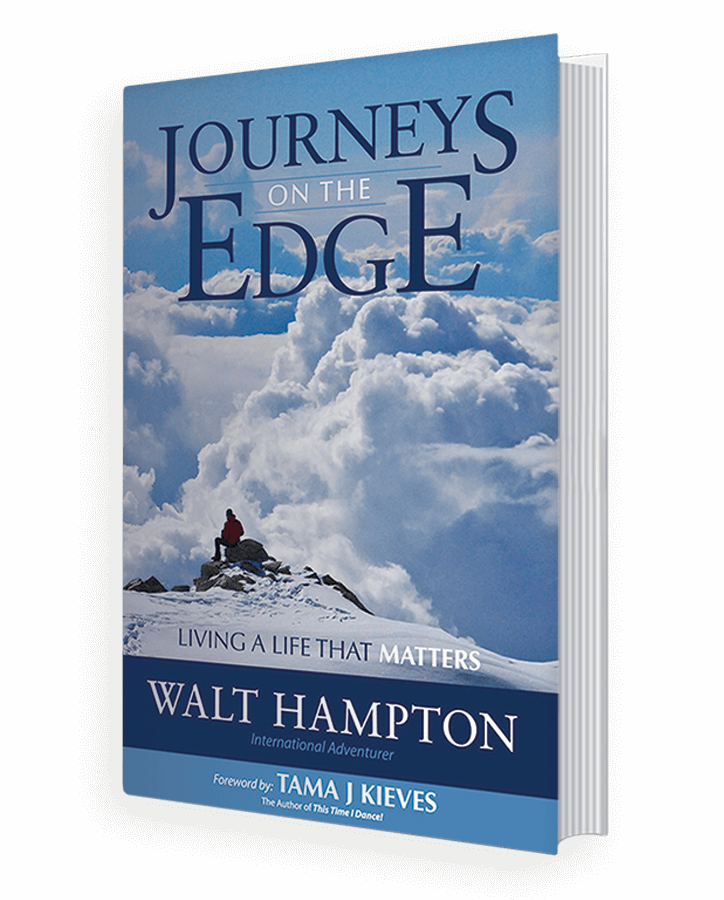
Do you have your copy of Journeys on the Edge: Living a Life That Matters? Order your signed copy today. Click HERE!


What Matters

“So what’s a life that matters?”

I must have looked as dumbstruck as I felt.

“The sub-title,” the man in the dark suit said, pointing to the slide on the screen. “You know, the sub-title of your book.”

Ah, my book, the one I’ve been talking about. Yes, of course. Living a life that matters.

Journeys on the edge, and all that… .

Hmmm. Haven’t had that question before… .

So with my usual grace, I punted.

“You already know the answer to that question,” I replied.

And the truth is, all of us do.

All of us know what truly matters. All of us know what makes our hearts sing. All of us know what feeds our spirits and nourishes our souls.

It’s just that we forget. It’s just that we get buried in the minutia. We lose ourselves in the urgent rather than tending to the important. We get sucked into other people’s agendas rather than our own.

Lost in rabbit holes of “busy,” glued to glowing screens, torn by technology run wild, assaulted by emails, inundated by updates, and addicted to the ephemeral connections of social media, we find ourselves running so fast that we forget where we are going, or why; caught and overwhelmed in a pace that both challenges and diminishes our humanity.

We lose touch with what matters.

Leadership expert Brendon Burchard suggests that at the end of our lives the questions we will ask of ourselves are these: Did I live, really live? Did I love, really love? Did I matter?

At the end of our lives, none of us will wish that we had spent more time in the office, sold more product, seen more customers, billed more hours. What will matter will be the experiences we have had, the lives we have touched, the love we have shared.

What will matter is whether we have listened to the deepest longings of our hearts.

The measure, according to Buddhist scholar Jack Kornfield, is regret. Will we be able to say that we have lived without regret?

The Carmelite mystic William McNamara says that “Drivenness and crowdedness scatter our perceptions so disparately that our lives become helplessly fragmented and we are inexorably reduced to uncollected dispersion and spiritual torpor. He suggests that “[m]ost of us will have to stop doing half the things we do in order to do the other half with the liveliness of faith and the contagion of love.” “[I]nsightfulness grows in stillness and tranquility,” he says.

In silence, with life stripped bare, we discover again what matters.

Clayton M. Christensen, writing in the Harvard Business Review shares these thoughts:

“This past year I was diagnosed with cancer and faced the possibility that my life would end sooner than I’d planned. Thankfully, it now looks as if I’ll be spared. But the experience has given me important insight into my life.

I have a pretty clear idea of how my ideas have generated enormous revenue for companies that have used my research; I know I’ve had a substantial impact. But as I’ve confronted this disease, it’s been interesting to see how unimportant that impact is to me now. I’ve concluded that the metric by which God will assess my life isn’t dollars but the individual people whose lives I’ve touched.

I think that’s the way it will work for us all. Don’t worry about the level of individual prominence you have achieved; worry about the individuals you have helped become better people. This is my final recommendation: Think about the metric by which your life will be judged, and make a resolution to live every day so that in the end, your life will be judged a success.”

As young philosophy students, we were challenged with the assignment of writing our own obituaries.

That will get you in touch with what matters.

In The Zone

Meet this transient world with neither grasping or fear, trust the unfolding of life, and you will attain true serenity.

— Bhagavad Gita

I love it when I’m in the zone.

It’s effortless.

It just flows.

You know what I’m talkin’ about.

  • You’re working on a project and everything just falls into place.
  • You’re writing and the words spill onto the page.
  • You’re painting and it’s as if the canvas paints itself.
  • You’re having fun; you lose track of time; and the hours become like seconds.

I experience it sometimes when I climb. The moves reveal themselves and suddenly I’ve topped out. Or sometimes when I’m running, it feels as if  I’m being transported across the ground, like pure fluid motion.

It’s our natural state: Flow.

Why is it then that we fight it? Why is it that we make things difficult? Why is it that we choose to struggle? Why is it that we feel a need to wrestle everything to the ground?

As if we could really control any of it.

You know I’m not saying “Que sera, sera.”

I believe that we are called to pursue our dreams, to train hard, to take the risks, to push the edges, to grab the ring; to transform ourselves; to transform our world; to make our lives a masterpiece.

But, why can’t we believe that the Universe conspires for our success? Why can’t we trust that an Infinite benevolence wants for our good? Why can’t we rest in the natural order of things?

Life unfolds as it unfolds.

Struggle is optional.

“Sometimes I have to remember not to struggle,” said Ann breathlessly. We were running downhill after a long run up.

How true that is. We get caught in our struggles. And it’s so easy to stay stuck.

It’s so easy to stay in that state of struggle rather than to allow the magnificence that is.

“We are rather like whirlpools in the river of life, Charlotte Joko Beck writes. It’s when we try to dam up our whirlpools and cut them off from the larger flow, that we struggle. We suffer. We stress. We self-isolate. We cut ourselves off from one another. We cut ourselves off from the perfection that is the unfolding. We forget our true natures; we forget that we are part of the stream of life.

When we step into the flow, we allow for infinite possibility.

There’s a reason for that old round: Row, row, row your boat, gently down the stream.

It’s so much easier to be the river than to row against it.