Walt Hampton, J.D.

Creating the Work & Life You LOVE

The Sunday Scaries

The Sunday Scaries

What if that Sunday afternoon dread is trying to tell you something?

In my family, we called it the Sunday klegsies.

I have absolutely no idea where the word came from. But everyone knew what it meant.

It was that awful feeling that would begin creeping in sometime on Sunday afternoon. A knot in my stomach. A growing sense of anxiety. The realization that Monday morning was coming, and another workweek was about to begin.

I was a trial lawyer for more than 25 years. The work was intense, demanding, and relentlessly contentious. There were deadlines to meet, clients to satisfy, and adversaries to battle. The pressure never really let up.

I was pretty good at it. And it paid well. But I hated it.

I’d count the days until Friday. By Wednesday, I’d be thinking about the weekend. Friday afternoon brought an enormous sense of relief, as if I could finally come up for air.

But the relief never lasted long enough. By Sunday afternoon, the klegsies would begin again.

Turns out, I had plenty of company.

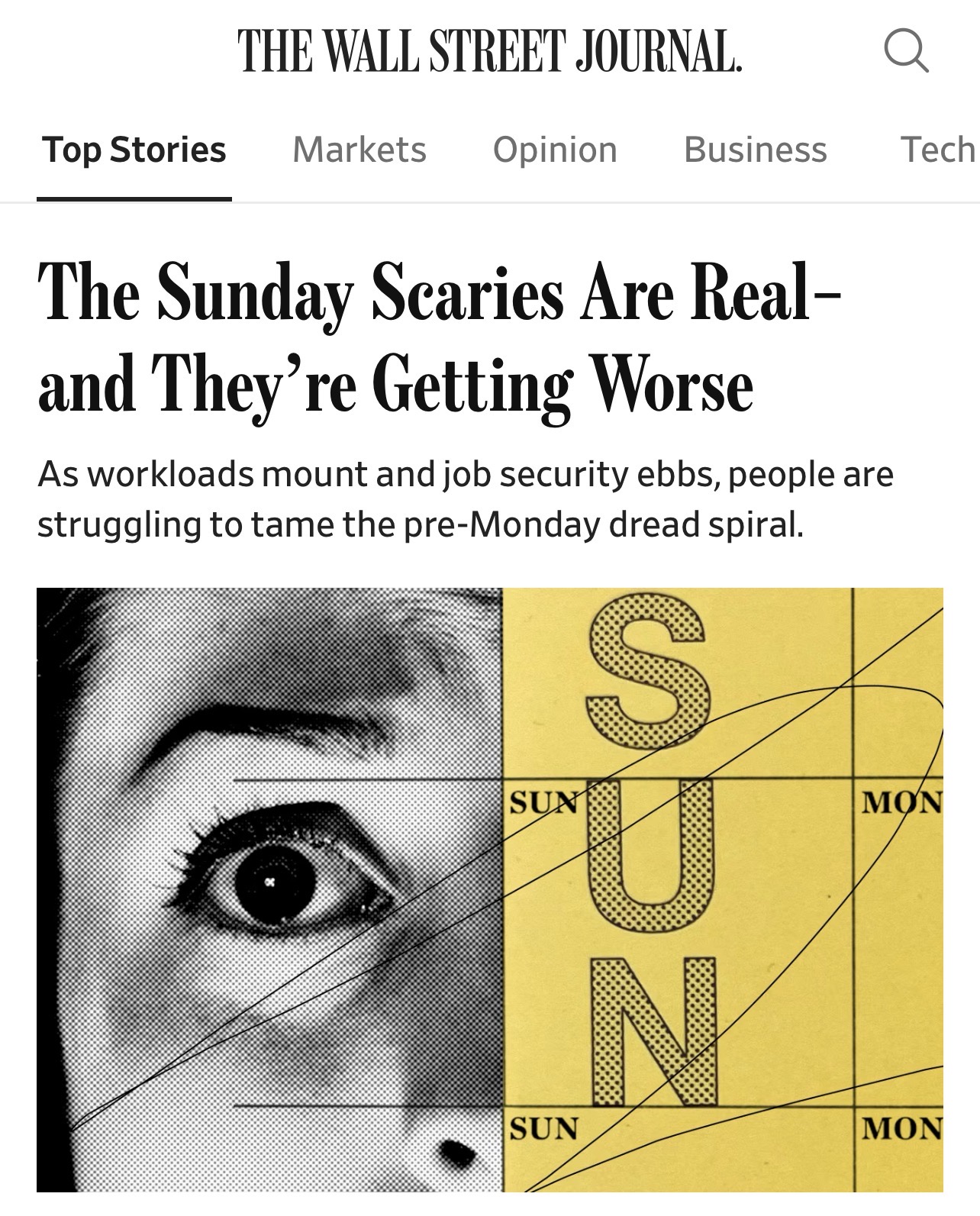
A recent Wall Street Journal article, The Sunday Scaries Are Real—and They’re Getting Worse, reports that more than half of American workers experience what we’ve come to call the Sunday scaries. And the phenomenon appears to be getting worse as workloads increase and job security becomes more uncertain.

The article offers some useful suggestions for managing that anxiety. Set better boundaries. Get organized before the weekend. Resist the temptation to spend Sunday catching up on work.

All good advice. But I wonder whether we’re asking the wrong question. Instead of asking how to make the Sunday scaries go away, perhaps we ought to be asking why they’re there in the first place.

For years, I knew something was wrong. I loved studying the law, but practicing it was another matter entirely. The constant conflict wore me down. I felt trapped in a profession that rewarded me financially while draining me emotionally.

So why didn’t I leave? Because I had responsibilities. Kids to raise. A mortgage to pay. A lifestyle to support. And because I was good at what I did, it seemed almost irresponsible to walk away.

A therapist I worked with called it the golden handcuffs. They were very real. Or at least they felt that way.

Looking back, I don’t regret the decisions I made at the time. I had responsibilities. But I wish I’d understood sooner that the skills I’d developed as a lawyer could serve me in an entirely different career. I had more options than I realized.

Eventually, I found my way into executive coaching.

And here’s the remarkable thing: I absolutely love the work I get to do. I love the people I work with and the opportunity to make a difference in their lives. I look forward to my days.

In fact, I’ve noticed something rather funny about Fridays. I sometimes feel a little melancholy when the workweek ends. I’m genuinely sorry to see it go. And I look forward to Mondays.

That doesn’t mean every day is easy. There are challenges and frustrations, just as there are in any profession. But there’s an enormous difference between working hard at something you love and working hard at something that’s slowly wearing you down.

There’s an old saying, often attributed to Mark Twain, that if you find work you love, you’ll never work a day in your life. I understand that sentiment now in a way I never could when I was practicing law.

Of course, not everyone can simply walk away from a job that makes them unhappy. I couldn’t. At least not for a very long time. And sometimes the Sunday scaries are the result of a particularly difficult season rather than a fundamental mismatch between who we are and what we do. But I think we ought to pay attention to what those feelings are telling us.

If you spend every week counting the days until Friday, and every Sunday dreading Monday, that’s worth examining. It may be time for a change in how you work. Or it may be time to begin imagining an entirely different kind of work.

You don’t have to make that change tomorrow. You might need to plan carefully, develop new skills, or create a financial runway that gives you room to move. But you can begin.

I wish I’d begun sooner.

Because one of the things I’ve come to understand is that the point of work isn’t simply to make a living. It’s to help us create a life worth living.

And while I wouldn’t wish those Sunday klegsies on anyone, perhaps they have something important to teach us.

Maybe they’re not something to get rid of. Maybe they’re something to listen to.
I Don’t Care How You Feel

I Don’t Care How You Feel

I had just finished speaking to a university audience on leadership and goal achievement, and had stayed on afterwards to chat with the students.

“I know exactly what I want,” my young listener proclaimed.

Looking earnest, he furled his brow. “It’s just that I don’t always feel very motivated.”

“I don’t really give a fuck what you feel,” I replied with an equal amount of furling and earnestness.

“If you know exactly what you want… and you want it badly enough, then you’ll show up every day and do what needs to be done whether you feel like it or not.”

He flinched, only slightly, as I jabbed my finger in the air for extra dramatic import: “Motivation is vastly overrated.”

And it is.

I rarely feel motivated to run, or go the the gym, or put on over mitts to go out into the arctic cold to climb. There’s not a whole lot of motivation going on when I think about driving three hours to a ski area or hoisting the kayaks onto the roof of a car. I almost never feel motivated to write. In fact, I’ve put off writing this blog until the very last moment possible, perhaps just to dramatically punctuate my own perpetual lack of motivation!

You see, motivation is flighty. It’s not dependable. It comes… and it goes. Sometimes it shows up; more often than not, it doesn’t. Even when it comes to stuff we like or want.

What’s important is the knowing. Knowing what you want. Knowing what you like. Knowing where it is you want to go. And why.

When you’re clear about your destination, when you know your outcome, then all you need to do is act. You’re pulled forward by the vision of what you will achieve. How you feel from moment to moment is irrelevant. In fact, your transitory ‘feelings’ usually just end up getting in the way.

I know how much I value my fitness and vitality over time when I run. And so I run. Whether I feel like it or not.

I know how much I love the creative process of writing and the sense of satisfaction I have when the words I have written have an impact on someone I have never even met. So I write. Whether I feel like it or not.

Get clear on what you really, really want.

Then get going. And stay at it.

In the meantime, it doesn’t really much matter how you feel.

Do It Scared

Do It Scared

When I was a lawyer, I was successful. I was making good money. On the outside, it looked like I had it made.

But on the inside, I was miserable. The work didn’t light me up. It drained me. I remember sitting in my office one night long after everyone else had gone home, looking out over the city, and thinking, Is this it? Is this what I’m going to do for the rest of my life?

I had a vision for something different. I wanted to create a coaching practice. To help people live more intentional, fulfilling lives. But the chasm between where I was and where I wanted to be felt terrifying. Too vast to cross.

So, I stayed stuck. For years.

Looking back, I see it clearly now. It wasn’t the lack of opportunity that held me back. It wasn’t the market, the timing, or my obligations. It was fear. Pure and simple.

Fear of failure.

Fear of what others would think.

Fear of losing what I had, even if what I had was slowly killing me inside.

The truth is, fear is one of the most powerful forces in the world. It can keep us trapped in jobs we hate, in relationships that don’t serve us, and in stories that no longer fit who we’re becoming.

And right now, there’s a lot of fear in the air. Cultural fear. Political fear. Financial fear. The world feels uncertain. And when fear is in the air, paralysis follows. People stop creating. They stop imagining what might be possible. They hunker down and play small.

That’s what fear does. It convinces us to trade our dreams for safety.

Susan Jeffers wrote a wonderful book years ago called Feel the Fear and Do It Anyway. The premise is simple. Fear never really goes away. Waiting for fear to disappear before we take action is like waiting for the wind to stop before setting sail. It’s not going to happen.

The only way to move forward is to do it scared.

Those three words, “do it scared,” have become a mantra for me and for so many of my clients.

When a client tells me they’re stuck, one of my favorite questions to ask is, “What would you do if you weren’t afraid?” It’s amazing how that one question can open the door to possibility. You can see the light flicker on in their eyes. The energy shifts. They start to imagine a different story.

Because when we set fear aside, even for a moment, we remember that we have power. We remember that the only way forward is through.

Here’s what I’ve learned: courage isn’t the absence of fear. It’s action in the presence of fear. Every meaningful thing you’ve ever done, you’ve done while afraid. The first day of school. The first big presentation. The first time you said, I love you.

You didn’t wait until you weren’t afraid. You just did it anyway.

If you find yourself feeling stuck right now – unsure of what comes next, overwhelmed by the noise of the world – try this:

Take a few quiet minutes today. Close your eyes. Breathe. Ask yourself, What would I do if I weren’t afraid?

Then listen.

The answer might surprise you. It might be small—an email to send, a phone call to make, a boundary to set. Or it might be big—a business to start, a move to make, a new chapter to begin. Whatever it is, take one small step toward it.

Don’t wait for the fear to go away. It won’t. But it will shrink with each step you take. Because action dissolves fear.

That’s how we grow. That’s how we create lives that matter.

If I had waited until I wasn’t afraid to leave law and begin coaching, I’d still be in that office, looking out over the city lights, wondering what could have been.

Don’t let that be your story.

Do it scared. Feel the fear and move forward anyway.

When you’re not afraid, the world opens up. And you realize it was never as big a leap as you thought.

Need help? Let’s talk. Email me: [email protected]

Finding What’s Next

Finding What’s Next

Jacob has multiple advanced degrees. For the last 12 years, he’s led a large organization as its executive director.

And he’s been extraordinarily successful.

He’s built an amazing team. The organization has grown and thrived under his leadership. By every metric, and certainly by all outward appearances, Jacob has had a great run.

There’s just one problem.

He’s done.

Not burned out exactly. Not unhappy. He just knows he’s taken the organization about as far as he wants to take it. The work that once energized him doesn’t anymore.

He wants a new career.

But he has absolutely no idea what it should be.

I see this all the time in my coaching work. People arrive at my doorstep after 15 or 20 or 30 years of doing something they’ve become very good at. They know they want a change, sometimes desperately, but they can’t for the life of them figure out what comes next.

Part of the problem is that success has a way of narrowing our field of vision.

You’ve spent years becoming known for something. You have a title that carries weight. You’ve built a reputation and a network around the work you do. The money may have been pretty good too.

Eventually, all of that gets tangled up with identity.

I remember this from my years practicing law.

I’d walk into a networking event and inevitably someone would ask, “What do you do?”

“I’m a lawyer,” I’d say.

If I wanted to sound particularly impressive, I could upgrade that to: “I’m a trial lawyer.”

There was a lot packed into those few words. Education. Status. Expertise. Years of experience. And, whether I wanted to admit it or not, ego.

The trouble is, I wasn’t a lawyer.

I practiced law.

There’s an enormous difference.

When we identify too closely with a role, it becomes difficult to imagine ourselves outside it. We look at the future and think we have to find another box that somehow accommodates the person we’ve been.

But a career isn’t a box. And your job title has never captured the whole of you.

Over the years, you’ve acquired ways of thinking, solving problems and navigating difficult situations. You’ve learned things about people. You’ve discovered what you’re unusually good at, often without noticing because those abilities have become second nature.

None of that disappears when you leave your office and hand back the keys.

I wish I’d understood that sooner.

When I wanted to leave the practice of law, I could see everything I would be giving up. I wasn’t nearly as good at seeing what I could take with me.

Years later, when I became an executive coach, I discovered that much of what I’d learned as a lawyer came along for the ride. I knew how to listen carefully, I could hear what wasn’t being said; I knew how to get underneath a problem and ask questions that might reveal what was really going on.

And here’s the truth: My old career wasn’t wasted time. It had been preparing me for work I couldn’t yet see.

Which brings me back to Jacob.

He and I could have started by looking at job postings. We could have inventoried his credentials and searched for roles where an experienced executive director might fit.

Instead, I asked him a different question.

“What draws you here?” I said, putting my hand over my heart. “What tugs at your heart?”

Because I’ve come to believe that the heart often knows long before the résumé does.

Finding what’s next may require loosening your grip on the person you’ve worked so hard to become. Not abandoning that person. Just making room for someone else who has been quietly emerging along the way.

You may not know the title yet.

That’s OK.

Start with the tug.

Just Because You’re Good Doesn’t Mean You Should

Just Because You’re Good Doesn’t Mean You Should

I loved law school.

There was joy in the study, in the debates, in the intellectual challenge of taking a problem apart and looking at it from every angle. I loved the conversations with classmates and the chance to sit with difficult questions long enough to understand the nuance.

Then I became a lawyer, and almost immediately, I knew something was wrong.

The practice of law felt nothing like law school. There wasn’t much time to read and reflect or savor the complexity of an issue. There was work to get out the door, deadlines to meet, clients to serve, and hours to bill. (Two thousand of them a year!)

My life was measured in six-minute increments.

I was also a trial lawyer, which meant spending a huge amount of time in conflict. That’s how the adversarial system works, of course, but year after year the contentiousness wore me down.

The problem was that I was really at it. And it paid really well.

So even though I wanted out, leaving didn’t feel simple. I had kids, a house, tuition bills and responsibilities. A therapist I worked with at the time called them the golden handcuffs, and the phrase fit perfectly.

The career that was making me miserable was also providing the income, security and identity that made leaving feel almost impossible.

And there was another trap I couldn’t see as clearly then: I had invested years becoming good at this.

Law school. The bar. Long days and late nights. Years learning how to try cases, take depositions, write briefs, negotiate settlements and advise clients.

Walking away from all of that felt wasteful.

That is how a lot of people stay stuck.

We assume that because we’ve invested heavily in something, we need to keep investing in it. Economists call this the sunk cost fallacy. The money is already spent. The years are already gone. Yet we keep allowing those past investments to determine what we do next.

But wait, there’s more! There’s another assumption underneath that one that may be even more powerful.

If I’m good at something, surely I’m “supposed” to keep doing it.

But competence and fulfillment are not the same thing.

You can be very good at work that is slowly hollowing you out. You can keep earning more money and still become less happy with the life that money is supporting.

From the outside, everything might look amazing. But on the inside you’re miserable.

It took me far too long to understand that.

I stayed in the practice of law for more than two decades.

Years later, I became an executive coach, and I absolutely love the work I get to do.

I love the conversations and the chance to help people see what they cannot quite see for themselves. I love sitting with a complicated business or life problem long enough for something useful to emerge.

And much of what made me a good lawyer came with me.

The ability to listen carefully, spot patterns, think strategically, ask difficult questions and help someone make sense of a complicated situation did not disappear when I left the law.

I didn’t throw away those years. I simply started using what I had learned in a different way.

I wish I had understood that sooner.

We often imagine a career change as starting over, but that’s not always what ‘s happening. More often than we realize, we carry a great deal with us. The skills, judgment and experience travel even when the profession itself does not.

Here’s what’s true: There nay be something in your own life right now that you are extraordinarily good at. People may admire you for it. They may depend on you for it, and it may pay you very well. But it doesn’t make your heart sing.

That doesn’t make the years you invested meaningless, and it doesn’t mean you made some terrible mistake by staying as long as you did. It may simply mean that the work served you for a season, and that the life you really want right now requires something different.

Just because you’re good at something doesn’t mean you should spend the rest of your life doing it.

I help people find the work and the life they love. If you’re even just the tiniest bit curious, email me: [email protected]

DOWNLOAD your FREE BOOK!

The-3-steps-to-living-an-inspired-life

DOWNLOAD Your Free E-Book NOW! Click Below And Get Going!

Click on the button for your copy of journeys!

Journeys-On-The-Edge

You’ll Get A Signed Copy!

Click on the button for your copy of my brand new book “The power principles of time mastery!”

The Power Principles of Time Mastery

You’ll Get A Signed Copy!

REGISTER HERE

Free Online Training Workshop

Thanks for signing in to the workshop!