Walt Hampton, J.D.

Creating the Work & Life You LOVE

The Good Word

Like moths drawn to a flame.

The earthquake in Turkey. A tsunami in Indonesia. The debt crisis in the U.S.; the Euro crisis in Greece. Iran wants the bomb. Unemployment is at 9%. Al Qaeda lurks. The environment is in peril. The Democrats are ruining the economy. The Republicans too.

We never have to go far to find bad news.

People love  it.  Many are drawn to it like moths to a flame.

News stations thrive on it. The starker, the more catastrophic, the better. And the more graphic, the more enthralled and fixated the doom mongers become.

It’s a waste.

I grew up in a household of worriers, worrying incessantly about what might go wrong, stewing in the grimmest of possible outcomes: the economy is sure to collapse, there won’t be enough money to pay the bills, the mole is sure to be cancer, the weather will be the worst it has ever been.

Seth Godin writes in his blog this week: “Worrying is not a useful output. Worrying doesn’t change outcomes. Worrying ruins your day. Worrying distracts you from the work at hand. You may have fooled yourself into thinking that it’s useful or unavoidable, but it’s not.”

The events of our lives have as much probability of turning out just fine as not. Worry is a waste.

The same can be said about bad news.

Bad news sucks our spirits, dims our hopes, dulls our sense of possibility.

Why fixate on the bad? There is so much good.

Seek what is good.

Seek out the good. Soak in it.

I have three practices I want to share and recommend for your consideration:

  1. Keep a gratitude journal. Every morning, as part of my journaling practice, I list a dozen or so things for which I am grateful.  For example, my morning list might include: “I am grateful for my health.”  “I am grateful for my home.”  “I am grateful for the opportunities I have.”
  2. Make a “good things” list. And the end of the day, when I review everything that unfolded, I write down at least three good things from the day, things that went particularly well, things in which I found joy. The list might include the new client that came in the door, the wonderful dinner with good friends, or the magical dawn light on my morning run.
  3. Ask about what’s good. Most often, when we see someone we know, we ask, “How are ya?” This, of course, elicits a broad range of responses like “busy,” “hangin’ in there,” and “same shit different day.” Instead, consider being a herald of the good. I like to ask “What’s the good word?”

Joel Osteen, in his new book Every Day A Friday, writes, “Whatever challenges you face, whatever circumstances are weighing you down, you can choose your response. It’s not what happens to you or what you have or don’t have that is important; it’s how your mind is set and the decisions you make. How you live your life is totally up to you. It’s not dependent on your your circumstances. It’s dependent on your choices.”

What you focus on expands. Focus on the good.

______________________________

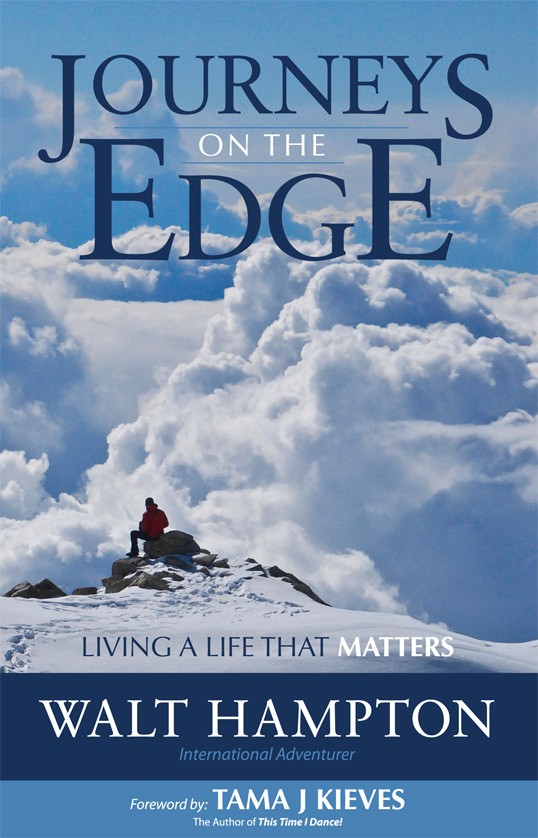
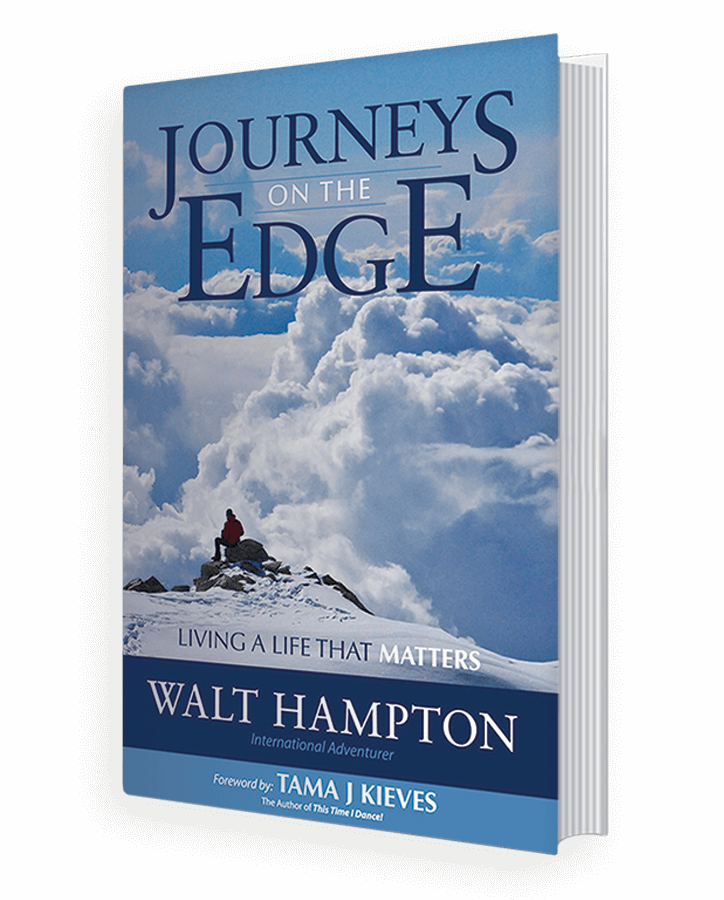
Walt Hampton’s new book Journeys on the Edge: Living a Life That Matters now available. CLICK HERE to order your signed copy.


Life Is Not A Marathon

It’s an Ultra!

It’s amazing how fast significant events can disappear into the rear-view mirror of our lives. It was nearly a month ago already that we ran the Vermont 50. Yet despite the passage of time, I keep realizing how many lessons I learned in the hills around Ascutney.

I used to think that life was like a marathon. I don’t think so anymore. Now I think it’s more like an ultra. Here’s why:

1. The need to take better care of ourselves.

There is no question that marathon training is difficult.  And 26.2 miles is a long way to run.  But it’s possible to run a marathon, get a bit dehydrated, allow yourself to get nutritionally depleted, and still walk away relatively unscathed.

Not so with an ultra.  Over 50 or 100 miles, it is critical to attend meticulously to the needs of your body.  You can’t afford to get dehydrated.  It’s essential to continually monitor your electrolytes. You need constant fuel to go the distance. 

How easy it is to ignore our bodies in our lives. When I’m out speaking to groups on the message of Journeys, when I urge folks to be active participants in their lives, the familiar refrain I hear is: I’m too old, too overweight, too out of shape.

It is axiomatic that without our health we have nothing. And yet how cavalier we are with the care of the  vessels that enable us to make manifest the very essence of who we are in the world.

Small tweaks in diet and exercise can transform how we feel about ourselves; and can transform our lives. At our ideal weights, we can sometimes feel like we can fly.

The death of Steve Jobs is a stark reminder that all of the fame and fortune and success and notoriaty on the planet cannot save us from consequences of ill health.

We need to care for our bodies well if we’re going to go the distance.

2. It’s about endurance not speed.

I remember being preoccupied in my marathon training about time.  Would I finish sub-4? Would I have a “qualifying” time? Would I beat Ann?  How fast could I be?

In an ultra, there is a lot more plodding. And for me, running 50 miles was not about the amount of time it took me; it was about being able to go the distance. Sure there was a time limit. But it mattered much less to me how fast I ran it than being able to cross the finish line.

We are constantly challenged by the need for speed in our lives with the constant barrage of emails and voicemails and status updates. Yet what really matters is our ability to persist.

Those of you who read me frequently know that I am a big fan of Darren Hardy’s metaphor of the hand pump, one of those old metal things you see at a campground. He says that when we engage in a big life project – at work, in school or in our creative lives – we need to make slow, steady, constant efforts toward our goal. As we continue “to pump the handle,” at first we see just a slow trickle of results for all our work. (If we stop, we need to start again.) But if we continue to pump steadily, eventually a huge torrent flows.

Jack Canfield says that even the mightiest tree in the forest can be felled with just five whacks of the axe each day, so long as we don’t give up.

Small consistent steps over time lead to magnificent results.

Persistence is the key.

3. We get to stop and re-group.

When I first started my distance training, I freaked out when Ann suggested that we stop and hydrate and have a snack. Stop?  How can we stop? We’ve gotta run a race! We can’t stop! We’ll fall behind! Our muscles will seize up. All will be lost!

Well, in running ultra distances, there’s a lot of stopping.

We need to be a lot better about this in our lives. And I am guilty as charged! They say that we teach what we most need to know and this is a lesson that I need to constantly remind myself to follow.

We seem to think that busy means that we are productive. And this is not necessarily so. In fact, last week I wrote: busy is bad.

Busy will burn us out. And yet the world drives us forward. Our egos drive us forward.

How essential it is to stop. To reflect. To rest. To recreate. To think about where we’ve been; to consider where we’re going. To connect again with those we love; to connect with our essential selves; to connect with the ground; and with the Ground of All Being.

If we’re going to go the distance, we gotta to stop and regroup. Often.

4. We can suffer for a long time and still be ok.

Before I met Ann, I hadn’t run more than 8 or 10 miles. When I went out beyond 10 for the first time, I thought I was going to die.

As I extended the distances out, though, I discovered that the entire range of physical and mental feelings ebbs and flows; that there is a constant state of flux. I found that I could run 15 miles like the wind, 10 miles as if my legs were bound by piano wire; and another 5 as if I were a flowing river. All on the same run!  And I discovered too that even if I were miserable for 20 miles, it could all change in an instant – and it would be ok.

In every day of our lives, we go through the range of emotions. Some affirmation from a co-worker will lift us up; the all-too-busy boss becomes a sure sign that we will lose our job; the ungrateful teenager enrages us; a smile from a passer-by makes our heart sing; our exhausted spouse hurls us into a lonely despair. Over and over again.

And we will be ok.

A relationship unwinds. A loved one dies.  We have no idea whether the house will ever sell. Or whether our kid will get into school. Or whether there will ever be work again.

And we will be ok.

It is so easy to lose faith in ourselves; in our abilities; in our resiliance.

We shouldn’t. We can prevail. We will.

5. It’s a banquet, a really nice banquet.

On a short run, you start and you finish. In marathons, there are places to fill your water bottles every now and then. And perhaps pick up a package of Gu.

When I first started thinking about ultras, I was told that they were like running buffets or banquets. And they are!

Every 5 or 6 miles or so in an ultra, there are long tables of goodies: sandwiches and bananas and cookies and crackers and fruits and nuts and candies and gummies and all sorts of other fun stuff.

Life is like that: it’s a banquet.  And we forget. We forget how good it is. We forget to stop along the way and peruse the table and fill our pockets and satisfy our hunger and our thirst. We hurtle forward, missing the majesty that lays before our eyes.

We miss the sunrises and the sunsets and the northern lights and the shooting stars. We miss our lover. We miss the child who wants to connect; the parent who wants to be remembered; the co-worker who needs a hug. We miss the garden and the fall colors and the fine wine and the bountiful harvest. And one day becomes the next.

And before you know it, the ultra is done.

Linger at the banquet. It’s ours to enjoy.

Journeys on the Edge: Living a Life That Matters Click here to get your signed copy now!


Busy is Bad

The need to leave a legacy is our spiritual need to have a sense of meaning, purpose, personal congruence, and contribution.

— Stephen Covey

I got caught up short recently with a question about Journeys on the Edge: Living a Life That Matters.

The question: Doesn’t every life matter?

The answer: Of course.

But most of us want something more than simply to have existed.

Most of us want to make a difference, an impact on the world, however small. Most of us want our lives to really mean something.

In Abraham Maslow’s ground- breaking book Motivation and Personality, he suggests that, after our baser needs have been met, the need for self-actualization remains. Victor Frankl, who later contributed to Maslow’s work, calls it man’s search for meaning.

Meaning is what we seek.

Contemporary leadership expert Brendon Burchard says that, at the end of our lives, the questions that will remain are: did I live (did I REALLY live), did I love, and did I matter?

We want to have mattered.

If this is so, the work we must do is legacy work. And not just busy work.

Legacy work serves the greater good; it impacts the world in ways large and small. Just a few examples:

  • Teaching
  • Caring for the land
  • Advocating for justice and peace
  • Healing the sick
  • Protecting the downtrodden
  • Making fine art
  • Inspiring greatness

The Bill and Melinda Gates Foundation does legacy work. Steve Jobs did legacy work. John Rockefeller did legacy work.

But fame and fortune aren’t required to do legacy work. Rosa Parks did legacy work. Paul Rusesabagina did legacy work. Oskar Schindler did legacy work.

Legacy work can be, as Mother Teresa said, small things done with great love.

Here’s a tip for deciding whether you’re doing legacy work:

  • Ask this question: will the outcome of this investment of time, this project, this effort, this negotiation, this argument matter a week from now, a month from now, next year?
  • If the answer is no, take some time to refocus and redirect your efforts.

Legacy work is like a pebble thrown into a pond.  It ripples outward touching distant shores we cannot see, and perhaps cannot even imagine.

Legacy work is work that makes a difference. It is what we all long to do.

Busy work depletes. Busy is bad.

Bees can be busy. You… not so much.

Of course, the garage needs to be cleaned, the closets organized, the laundry folded. But if our lives consist only of busy work, we end up feeling like a stunt double in Groundhog Day. We end up exhausted and empty and sad. At the end of the day, we fall into bed and ask, “Is that all there is?”

The answer is no. There’s so much more, if we but choose.

Those of you who read me regularly know that I’m a big fan of action.  Action. Not busyness. Action not for action’s sake. But action that leads somewhere. Action that is about significance. Action that makes manifest the essence of who you are in the world.

Bold action. Brave action. Mighty action. Creative action.

Legacy action.

Are you doing legacy work? Or busy work?

__________________________

Journeys on the Edge: Living a Life That Matters

Available now at: www.walthampton.com

Family Values

The Tea Party loves them. The Republicans and the Democrats love them. Everybody loves them.

Values.

But what are they? The way folks talk about them, you’d think that they were wrought by Michelangelo or hanging in the Louvre.

Values are things that matter. Sure, there are probably some objective values. The Framers of our Constitution sure thought so: life, liberty, the pursuit of happiness, and all that.  But, really, values are things that matter most… to you.

So what matters?

For me, it’s

  • health and fitness
  • time for travel and adventure
  • my creative ventures; and
  • life with my partner, Ann

What are yours?

Here’s an interesting exercise I do with coaching clients:  Pull out an 8 1/2 x 11 piece of paper. Draw a line down the middle. On the left hand side, list your top 5 values; on the right hand side, list the top 5 places you spend your time.

It would be great if you had a match with both columns.  Most folks find they don’t.

And here’s the scoop: Where you devote your time is really what you value.  You can say that you value fitness and never go to the gym. You can say you value health, and never cook a dinner. You can say you value reading, and then spend your nights in front of the tube. You can say you value your family, and then work 80 hours every single week in the office.

But there’s good news:  If there’s an incongruence that you don’t like, you get to switch it up.  You get to spend your time on what you really value.

I know. Easy to say. Not always easy to do.

I was faced with an interesting, and very challenging, dilemma this past week.  Without any advance notice, I was asked to make a court appearance on behalf of a client I had represented years ago, in a court across the state, two hours before it was slated to begin. It wasn’t the client who asked. It was the court. And the court was going to see that my fee was paid.

Now I like to please the court. I really do. I liked this client a lot. He was one of my favorites. And it would have been nice to make a few unexpected bucks.

By most objectives measure, it was something I should have done.

I declined.

I was on my way out to the gym; I would have had to have skipped my workout (see #1 on my list above). I likely wouldn’t have been home in time to make dinner with Ann (see #4 on my list). And I would have lost an entire afternoon of creative time for the preparation of a workshop I’m leading (see #3). Which would have required that I work much later into the night (see#1 and #3). Which would have resulted in… . You get the idea.

Deciding how and where we spend our time can be tough. Here’s what works for me:

  • Be absolutely crystal clear on what you value.
  • Write down what you value on a sticky memo; put it on your computer monitor.
  • Whenever you’re faced with a decision as to how to allocate your time, ask “Is this really consistent with what I value?”
  • Get good at saying “no.”
  • And a warning: if you find yourself saying “this is something I should do,” you probably shouldn’t.

You’ll never get this right 100% of the time. But the effort is worth it.

You’ll be saner. You’ll have more time. And you’ll be living your life on purpose.

Now, that’s something to value.

Discover how to break away from “Survival Mode.” Live with purpose, passion and possibility. Find fun, freedom and fulfillment. You can have it all. I’ll show you how. Journeys on the Edge: Living a Life That Matters. Available now at: https://www.walthampton.com

My Day With Fiddy

I ran the Vermont 50 this past week, an ultra marathon, a trail run with an elevation gain of 8900 vertical feet, 50 miles long.

It was epic. Even as I write this I am fairly certain that my quadriceps have been beaten with railroad ties.

Years ago, as we set out on our first climb of the Grand Teton, my friend Rachelle stood at the base, looked up and said, “Well this doesn’t look very probable.”

I had the same thought at the start of the Vermont 50.

We had read lots of books and articles. We had trained for more than 16 weeks. But as I stood in the pre-dawn light waiting for the gun, all I could think was: Fiddy miles is a long way to go.

Eleven hours and ten minutes later, I crossed the finish line. I came away with lots of lessons. Here are three.

Ya Gotta Chunk It Down

I remember the elation I felt graduating from law school. And then the despair of realizing that the bar exam was a mere two months away. I had to review, condense, consolidate and assimilate three years of course work in just 8 weeks.

Every big expedition or project or goal since then has required the same approach: break it down into small manageable steps. Map it, lay it out, schedule it, and then go at it one step at a time.

Training for the ultra – one twelve hour span of time -required months and months of preparation. Running, fitness, diet, strength training.

Every day was planned. How many miles we would run. What we would eat. When we would go to the gym. Our travel, our commitments, all revolved around our training schedule.

Piece by piece we built the fitness. And when I stood at the line, I knew that I’d have to run the race in the same way. Biting off the entire thing would freak me out. But when I thought about it in three mile segments or five mile segments, it became imaginable.

Whether it’s a diet, an exercise program, a creative project, or a job, when the task is monumental, you need to break it down into small manageable steps. Map them out, write them down. Go at them one small step at a time.

Change Is The Only Constant

The Greek philosopher Heraclitus said, “The only constant in life is change.” The Greeks have no corner on this point of view. The Buddhists say it too.

And it’s true. Nothing stays the same. Everything is in flux.  All the time.

During the training, there were good days and bad days. There were days of pure elation. And days of utter despair.

Ofttimes without any rhyme or reason.

We could have a day of pure flow; and the very next day, it might feel as if our legs had turned to rebar. On long runs, five joyful miles could turn into ten of pure agony; and then back again.

We learned that every training day was different. We learned not to be driven by how we felt because of how transitory feeling are. And that it was ok.

On ultra day, it was the same. There were moments of great happiness and joy. At times our bodies seemed like they could fly. We would talk and laugh and enjoy the beauty of the land. And then, in an instant, discomfort, pain, exhaustion, distress and tears.

Knowing that it will all change, accepting the change, being with the change,  and ultimately riding the change: these were some of the biggest challenges we faced.

They are some of life’s biggest challenges as well.

When You Can’t Go Further You Can

It took my breath away when she told me: Ann was dropping out of the race. Her pace had been slipping. She wasn’t going to make the cut off times. She wanted me to keep going.

This was a finish line we were supposed to cross together. We had trained together. And planned together. I didn’t know how I would go on without her.

And I was completely spent. My feet were torn up. My legs ached. My spirit was in the toilet.

I taped my feet and changed my shoes and lumbered off into the woods with the tears streaming down my face. Eighteen miles to go.

I kept up the self talk: “You’ve done 18 before.” “In four hours, you’ll be sipping a beer.” “Your feet will heal.” “The pain will go away.” “You can do this.” “Just make it to the next aid station.” “Just one more mile.”

Then just one more step, and one more, and another after that. And then in the distance, I could hear the music playing: the finish line. The tears came fresh and fast, now because I knew that I could do it, that somehow I had dug deep enough, and pulled it off.

We have such a small taste of what we are capable of as human beings. Physically, emotionally, spiritually. We can taste it in our toughest moments. Yet, for the most part, our true strength remains a shadow. When all seems lost, when we’re sure we can’t do more, when we’re convinced we can’t go further, we usually can.

Henry Ford said “Whether you think you can or can’t…you are right.” You might as well think you can.

What I Know From Fiddy

Relentless Forward Progress was our ultra training manual.

Fiddy whispered: Be relentless.

DOWNLOAD your FREE BOOK!

The-3-steps-to-living-an-inspired-life

DOWNLOAD Your Free E-Book NOW! Click Below And Get Going!

Click on the button for your copy of journeys!

Journeys-On-The-Edge

You’ll Get A Signed Copy!

Click on the button for your copy of my brand new book “The power principles of time mastery!”

The Power Principles of Time Mastery

You’ll Get A Signed Copy!

REGISTER HERE

Free Online Training Workshop

Thanks for signing in to the workshop!